Select a site alphabetically from the choices shown in the box below. Alternatively, browse sculptural examples using the Forward/Back buttons.
Chapters for this volume, along with copies of original in-text images, are available here.


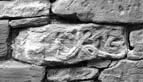
Object type: Part of cross-shaft or panelled cross
Measurements: H. (width as set in wall) 32 cm (12.6 in); W. (height as set in wall) 11.2 > 9.6 cm (4.4 > 3.8 in); D. unknown
Stone type: Pale olive (10Y 6/2), non-calcareous, poorly sorted, clast-supported, dominantly medium-grained, micaceous sandstone. The sub-angular to sub-rounded quartz grains vary from 0.2 to 0.4 mm across, but are mostly in the range 0.4 to 0.7 mm. Raglan Mudstone Formation? (Lower Old Red Sandstone Group, Old Red Sandstone Super Group), Upper Silurian (Pridoli) age.
Plate numbers in printed volume: Ills. 503-4
Corpus volume reference: Vol 10 p. 284
(There may be more views or larger images available for this item. Click on the thumbnail image to view.)
The bottom of the stone is to the left in the photograph, where 8.6 cm (3.4 in) of the stone is uncarved. Above (to the right of this) the stone is carved with two linked closed-circuits of median-incised interlace, with cross-over strands which pass through loops and knots and mirror-image box points just above the bottom edge of the carved area. The background is cut-back by 1 cm (0.4 in).
The interlace design seems to be complete, suggesting that this might be a small carving which survives to almost its full height. However, if the identification of Clifford 2 below is correct, it is more probable that both are part of a larger monument — possibly a panelled cross, similar to those found in Monmouthshire and south Wales (Nash-Williams 1950; Edwards 2007; Redknap and Lewis 2007). Clifford 1 could be the lowest panel on one of the narrow side faces.
