Select a site alphabetically from the choices shown in the box below. Alternatively, browse sculptural examples using the Forward/Back buttons.
Chapters for this volume, along with copies of original in-text images, are available here.


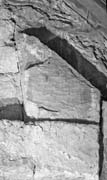
Object type: Panel with cut-back figure (from rood?)
Measurements: (after Taylor and Taylor 1965) H. c. 46 cm (18 in); W. c. 38 cm (15 in); D. unknown
Stone type: Probably oolite, but too high for detailed observation
Plate numbers in printed volume: Ill. 84; Fig. 31K
Corpus volume reference: Vol 10 p. 150
(There may be more views or larger images available for this item. Click on the thumbnail image to view.)
This stone is wedge-shaped, wider at the top than the bottom. The top part of the stone has been cut down to allow for the roof timbers of the present roof. The lower part of the stone carries what seems to be a cut-back torso with a sloping right shoulder. Above the torso there is a curving element which may be a halo. A series of vertical or slightly radiating lines is clear immediately above the 'shoulder' line, beside the 'neck'. On the right edge of the lower part of the stone, there are traces of three curving lines.
This may be the bust of a figure, perhaps a supporting figure beside the cross (in which case it is not in situ). Alternatively the 'halo' might suggest that this is a personification of the Sun or Moon (Sol or Luna), frequently part of the iconography of the crucifixion (Hawkes 2001, 241; id. 2002, 40, 45). If this suggestion is correct, and the stone is still in situ, then the figure would presumably be Luna. Taylor and Taylor identified this stone as possibly being part of the rood, and further suggested that a later corbel on the north side of the church might have removed a similar stone (Taylor and Taylor 1965, i, 75–6, figs. 33, 391).
