Select a site alphabetically from the choices shown in the box below. Alternatively, browse sculptural examples using the Forward/Back buttons.
Chapters for this volume, along with copies of original in-text images, are available here.


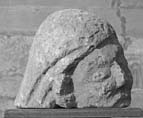
Object type: Head from rood figure
Measurements: H. 22 cm (8.7 in); W. 29 cm (11.4 in); D. 15 cm (5.9 in)
Stone type: Very pale orange (10YR 8/2), poorly sorted, matrix-supported, oolite. The ooliths, most of which have fallen out to give an aero-chocolate texture, sit in a sparry matrix. They vary in size from 0.3 to 0.7 mm, but are mostly in the range 0.4 to 0.6 mm. A few scattered, sub-rounded, shell fragments together with platy shell fragments up to 4 mm across, form about 5% of the rock. Ooliths and matrix occur in about equal proportions. Bath stone, Chalfield Oolite Formation, Great Oolite Group, Middle Jurassic.
Plate numbers in printed volume: Ills. 76-83; Fig. 31J
Corpus volume reference: Vol 10 p. 149-50
(There may be more views or larger images available for this item. Click on the thumbnail image to view.)
The head from a figure carving, rather smaller in scale than Bitton 1 and 2. The head is flat at the base, but otherwise carved in the round. The back of the head is roughly cut back. There is part of a small, circular, flat-bottomed recess on the top of the head, and two 'sawn' lines at right angles to each other radiate from this recess. This is probably the remains of the top fixing-socket for the figure. Alternatively it might be the seating for an added embellishment in metal — perhaps a halo, or the result of a later reuse of the original carving. The figure is looking to the left and wears a cloak or veil similar to the Virgin from Breedon-on-the-Hill, Leicestershire (Cramp 1977, 215, fig. 58). Faint inscribed lines curve across the surface of the cloak. The features are strong: the lips are full, the nose is broad and the eyes are bulbous. A comma-shaped feature on the right side of the head may be a lock of hair or the right ear.
See Bitton 1. This head probably belongs to one of the supporting figures from the large rood. It is the head of a female figure. In certain light, she appears to be looking up, while in different lighting conditions she seems to be looking down. In both cases, however, she is looking to her left and therefore must have been standing to the right of the cross. This is almost certainly the head of Mary the Mother of God.
