Select a site alphabetically from the choices shown in the box below. Alternatively, browse sculptural examples using the Forward/Back buttons.
Chapters for this volume, along with copies of original in-text images, are available here.


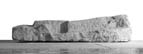
Object type: Left arm of rood figure of Christ
Measurements:
H. 38 cm (14.9 in); W. 84 cm (33 in); D. 18 cm (7.1 in);
Depth of carving 10 < 12 cm (3.9 < 4.7 in)
Stone type: Very pale orange (10YR 8/2), poorly sorted, matrix-supported, oolite. The ooliths, most of which have fallen out to give an aero-chocolate texture, sit in a sparry matrix. They vary in size from 0.3 to 0.7 mm, but are mostly in the range 0.4 to 0.6 mm. Platy shell fragments up to 6 mm across, form about 5 to 10% of the rock. Ooliths and matrix occur in about equal proportions. Bath stone, Chalfield Oolite Formation, Great Oolite Group, Middle Jurassic.
Plate numbers in printed volume: Ills. 68-75; Figs. 31G, 39
Corpus volume reference: Vol 10 p. 148-9
(There may be more views or larger images available for this item. Click on the thumbnail image to view.)
In his account of Bitton church, first published in 1878, Canon H. T. Ellacombe described the unblocking of a squint on the south side of the chancel-arch; he wrote that 'Among the fillings up was found a fragment of a bishop's effigy, with the colossal head and arm of the rood: fragments, no doubt, of the feet above.' (Ellacombe 1878, 9; id. 1881–3, I, 9); this account of the discovery has been followed by later scholars (e.g. Taylor and Taylor 1965, I, 74). Canon Ellacombe was born in 1790, became curate-in-charge of Bitton from 1817 to 1835 and vicar from 1835 to 1850; he lived until 1885 and was succeeded as vicar of Bitton (from 1850 to 1916) by his son, Canon H. N. Ellacombe. Canon Ellacombe (senior) thus had an exceptionally long association with Bitton, but he was in his late 80s by the time his account of the church was published. There are grounds for thinking that his recollection of events was faulty. Canon Ellacombe left a considerable quantity of manuscript material, now to be found in various archive centres. These materials include a Bitton Chronicle running from 1817 to 1850 (now Bristol Record Office P/B/I/8(a)). The Bitton Chronicle was copied c. 1950 by Mr C. P. G. Ketchley in materials collected for an unpublished history of Bitton (now Gloucestershire Archives, D1658/2). Ketchley's notes also include a transcript of material entitled by him 'Various notes by the Rev H T Ellacombe'; some cursory searches have failed to reveal the current whereabouts of the original manuscript of the 'Various notes'. As reproduced in Ketchley's transcript they include a day by day account of repairs in 1822–3, apparently written at the time. These notes indicate that that the discoveries were made in the course of the insertion of a window into the blocking of the arch to the former north porticus (the arch was itself first discovered at this time). The head (Bitton 3) was discovered on 26 August 1822 and the arm (Bitton 2) a few days later on 6 September; the account leaves it ambiguous as to whether the discoveries were made in the blocking of the arch proper or in a blocked doorway set within the blocked arch. The notes also indicate that the fragment of an effigy was discovered in the squint on the south side of the chancel-arch on 15 January 1823, and this perhaps explains Ellacombe's confusion more than half a century later.
The left arm of a larger-than-life figure carving. Probably part of an Anglo-Saxon rood above the chancel arch. Taylor and Taylor, in their reconstruction of the rood, indicate that the arm was in a sleeve, and Coatsworth and Tweddle have followed this interpretation (Taylor and Taylor 1965, i, 75, figs. 33, 392; Taylor and Taylor 1966, 6–8, fig. 2; Coatsworth 1988, 165, 189; Tweddle et al. 1995, 73–5). In a later article Coatsworth published new photographs and a more detailed description: '[the] fragment is the left arm of Christ stretched out on the cross. It is bent slightly at the elbow. The fingers are large and clumsy, with the little finger almost as large as the rest. The thumb is missing. Christ's arm is covered by a closely fitting sleeve. The hand rests on a deep roll moulding which crosses the end of the [cross] arm' (Coatsworth 2000, 172, pl. IVb). However, having examined the carving in detail several times, the present author believes that the arm is bare and that what has been interpreted as the cuff of a sleeve is the wrist bone on the lower side of the wrist, one side of a later socket on the top and the 'heel' of the palm in between (see detailed photograph and drawing: Fig. 39 and Ill. 74). The arm is carved in the round against a flat backing panel. Subtle details like the wrist bone, the joints in the fingers and the elbow are all faithfully reproduced. There is no sign of a nail head or a wound in the hand or the wrist. The outstretched hand crosses a deep half-round moulding which is part of a curving frame. The thumb has been removed by a square socket, either due to repair or perhaps as a joist-seating for a high level floor/ceiling later in the life of the church.
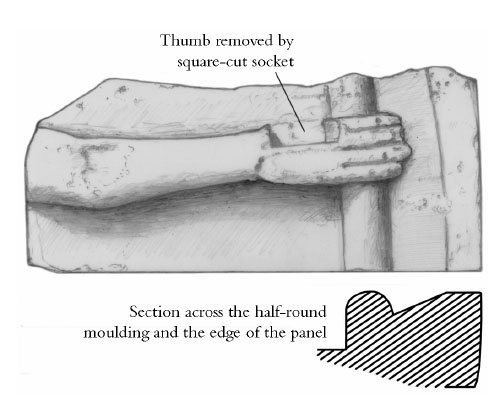
Fig 39
The arm of the larger-than-life rood showing the socket that has removed the thumb, perhaps for repair or during later reuse (Bitton 2) (scale 1:10)
See Bitton 1. The curving frame might suggest a mandorla and thus, perhaps, a Christ in Majesty rather than a rood, but the bare arm is a clear indication that this is a crucifixion. However, on a late tenth- or early eleventh-century Anglo-Saxon bone pectoral cross found near Lewes Priory in Sussex, the upper part of the crucified Christ (of Coatsworth type 1) is encircled by an oval mandorla (Beckwith 1972, 125, cat. 35, ill. 70). The curving moulding may, therefore, be part of a mandorla or an arched frame.
