Select a site alphabetically from the choices shown in the box below. Alternatively, browse sculptural examples using the Forward/Back buttons.
Chapters for this volume, along with copies of original in-text images, are available here.


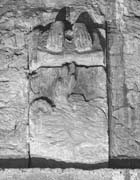
Object type: The feet of a rood figure of Christ
Measurements: (after Taylor and Taylor 1965, I, 76, who probably used Ellacombe's) H. c.107 cm (42 in); W. c.61 cm (24 in); D. unknown
Stone type: Probably oolite, but too high for detailed observation
Plate numbers in printed volume: Ill. 67; Fig. 31H
Corpus volume reference: Vol 10 p. 147-8
(There may be more views or larger images available for this item. Click on the thumbnail image to view.)
Part of an Anglo-Saxon rood above the chancel arch. All that survives in situ are two feet on a sloping plinth or suppedaneum above a serpent. The fragment probably consists of two stones — the feet being on one and the serpent on the other. The feet have long, well-defined toes. The head of the serpent rises out of rippling water. The creature has bulbous eyes, rounded jaws and a long tongue which touches the bottom edge of the plinth. Two coils of the serpent's body can be seen, one to the left (north) and one to the right (south) of the head. The coil to the left is very clear, that to the right is more fragmentary (see also Bitton 2 and 3 below).
This is part of a monumental carving, a larger-than-life rood that, with supporting figures, once covered the wall above the chancel arch. The figure of Christ, possibly surrounded by a mandorla (Bitton 2) was probably flanked by the Virgin Mary (Bitton 3) and St John, and by personifications of the Sun and Moon (Bitton 4). Taylor and Taylor offered a reconstruction of the rood, and, although they seem to have made it too big, it is clear that the contemporary roof and the north and south wall of the nave must have been much higher (Taylor and Taylor 1965, i, 75, fig. 33; Taylor and Taylor 1966, 6–8, fig. 2). Measurements taken from the separate arm (Bitton 2) suggest that the figure was probably 20% to 25% bigger than life, about 2.3 m to 2.4 m (7.5 to 8 ft) tall. The in situ feet would fit a figure of this scale.
There have been three valuable studies of tenth- and eleventh-century depictions of the crucifixion of Christ (Coatsworth 1988; Coatsworth 2000; Tweddle et al. 1995, 73–9) in which the Bitton figure has been mentioned. However, all three have followed Taylor and Taylor in assuming that the figure was clothed, and this has led to the Bitton figure being compared with other clothed figures of the crucified Christ in priestly robes triumphing over death. As will be seen below, the present author believes that the arm (Bitton 2) is, in fact, unclothed and, although it will never be possible to say exactly what the figure was like, he suggests that comparisons should instead be sought with figures such as the large rood from Romsey in Hampshire (Romsey II in Coatsworth 1988, 167–9, pl. 1b; Romsey 1 in Tweddle et al. 1995, 261, ills. 451–2). The Romsey roods depict Christ suffering on the cross, naked except for a loin cloth, and belongs to a group that Coatsworth calls type 1 — a completely upright, frontal figure with straight arms and legs (Coatsworth 1988, 167, n. 29). The Bitton arm (no. 2) is almost straight and the feet are side by side and point downwards at the angle of the supporting suppedaneum exactly like the Romsey figure.
Two elements are crucial in the discussion of the date of these large roods. One, the Manus Dei, the Hand of God, is not present among the Bitton fragments, but the other, the serpent below the suppedaneum, survives still in situ. Struck down beneath the feet of Christ, the serpent may symbolise Christ's triumph over evil, or, as Coatsworth suggests, the Fall redeemed through Christ's death on the Cross and possibly the old Law of Judaism superseded by the new Law of Christianity (Coatsworth 2000, 172). The snake beneath the crucified Christ's feet occurs on a late Carolingian ivory panel made (probably in Reims) for Charles the Bald in 860–70 (now on display in the Victoria and Albert Museum, no. 303-1867: Williamson 2010, 181, cat.43). Coatsworth notes that the serpent below the cross appears both with the robed and loincloth image of the crucifixion in Ottonian art (Coatsworth 2000, 172). The image also appears in late Anglo-Saxon manuscript illumination. The crucifixion that forms the frontispiece of Cambridge, Corpus Christi College MS 421, p.1 (Temple 1976, 99, cat. 82, ill. 254) is dated by a dedication in the manuscript to the second quarter of the eleventh century. This image contains most of the elements present at Bitton (a Coatsworth type 1 Christ, Mary looking up to her left, the serpent below the suppedaneum). Personifications of Sol and Luna are present with the Virgin Mary and St John on either side of the cross in a mid eleventh-century psalter from Winchester (British Library, MS Arundel 60, fol. 12v: Temple 1976, 120, cat. 103, ill. 312). Personifications of Sol and Luna (in this case with Stephaton and Longinus) are also present on a late tenth- or early eleventh-century Anglo-Saxon pectoral cross carved from walrus ivory and found in Norwich (Beckwith 1972, 125, cat. 34, ill. 71).
There is no pre-Conquest evidence for the history of Bitton, but the size of the surviving architectural remains of pre-Conquest date (comprising a large nave with north and south porticus), together with the ambitious scale of the sculpture, leaves little doubt that Bitton must have been a minster church. The church is sited in a characteristic minster location on a low terrace above the flood-plain of the Bristol Avon, and there was a large medieval parish with dependant chapelries (Ellacombe 1881–3).
