Select a site alphabetically from the choices shown in the box below. Alternatively, browse sculptural examples using the Forward/Back buttons.
Chapters for this volume, along with copies of original in-text images, are available here.


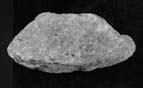
Object type: Holy Water stoup?[1]
Measurements:
H. 19.5 cm (7.7 in); W. 30 cm (11.8 in); D. (thickness of vessel wall) 12 < 14.5 cm (4.7 < 5.7 in)
External diam. (estimated) 60 cm (23.6 in); Internal diam. (estimated) 33.5 cm (13.2 in)
Stone type: Yellowish grey (5Y 8/1) shelly oolite with grains supported by sparry matrix. Ooliths 0.2 to 0.5mm in size with shell debris ranging from 5 mm up to 10 mm (mainly bivalve debris). Bedding visible parallel to the top and bottom of the block across the carved figure and picked out by changes in shell debris size. White Limestone Formation, Great Oolite Group, Middle Jurassic.
Plate numbers in printed volume: Ills. 732-4; Fig. 34K
Corpus volume reference: Vol 10 p. 381-2
(There may be more views or larger images available for this item. Click on the thumbnail image to view.)
According to Rudd (1937, 52, 114), this stone was originally built into the malthouse of Over Court, a substantial property to the west of the churchyard; the malthouse was demolished in the middle of the nineteenth century and the stonework was taken to Eastcombe Manor Farm (about 2 miles south-west of Bisley), which was then in course of construction. The stone was 'recognized there as Saxon by the late W. F. Randall and restored to the Church' at an unknown date. No documentation to support Rudd's account has been traced; for reservations as to Rudd's use of sources, see Jones (2007, 1).
Fragment of a cylindrical bowl showing two figures each under arcade arches, and part of a third arch. The arcade arches are decorated with three equal bands, the centre of which is pelletted. The arcade capitals have been cut back, but it still possible to see that they have curving chamfers. The original front faces of the arcade piers have been weathered back and no details survive. The figures themselves are simple, with large, rounded heads, that of the right-hand figure being rather more egg-shaped than the left. The faces are very weathered and damaged. The eyebrows and a small part of one eye survive on the left-hand figure and perhaps the mouth, but little else. The drilled pupil of one eye and again perhaps the mouth survive on the right-hand figure. The body of the right-hand figure is plain and outlined with a continuous round-profile moulding. The left-hand figure appears to be wearing a cloak, carved as a series of concentric bands around a narrow central panel with concave sides that rise to a sharp point at the top. Three round holes have been drilled into the outer face of the bowl — one through the centre of the right-hand pier, one just above the right-hand capital and one (now on the broken edge of the bowl) through the shoulder of the right-hand figure. The stone has been reused at least once, the inner face of the stone being partially re-cut to form what was probably a socket — perhaps to house one end of a beam.
Appendix K item (Fonts and stoups in the Western Midlands).
The figures on this fragment are very like those in the Book of Durrow, but cannot possibly be that early (Henderson 1987, 54–5, fig. 53). Similar figures occur on a ninth- or tenth-century cross-shaft from Masham in Yorkshire (Lang 2001, 172, ills. 646, 648), and on a late tenth- to early eleventh-century cross-shaft from Aycliffe in Co. Durham (Cramp 1984, 41–3, pls. 7, 8). The figure types and the pelleting on the arches of the Bisley fragment would suggest a date in the first half of the eleventh century. The profiles of the arcade capitals are similar to two tenth-century abaci from Gloucester (Gloucester St Oswald 19, 20) and to the eleventh-century imposts at Coln Rogers and Daglingworth in Gloucestershire (Coln Rogers 1, 2; Daglingworth 5–10). The Bisley capitals are also very close in form to the mid eleventh-century imposts at Odda's Chapel, Gloucestershire (Deerhurst Odda's Chapel 3, 4).
The carved surface of the stone is curved, and the inner face of the stone is also curved. This was clearly part of a bowl. Enough of the circumference survives to attempt a reconstruction of the size of the vessel. The diameter of outer face is about 60 cm (23.6 in), and that of the bowl 33.5 cm (13.2 in). It is possible to fit twelve arches around the circumference, suggesting that the figures might represent the twelve apostles. The bowl seems to be too small to be a fragment of a font (compared, for example, with the font from Deerhurst where the internal diameter of the bowl is 60 cm). Instead it is suggested that this is part of a stoup for holy water.
Only one of the three drilled holes in the outer face respects the design around the bowl and, while the holes may be part of a fixing arrangement or for some form of embellishment (for example, candle brackets), it seems more likely that they represent a phase in the later reuse of the stone noted in the description above.
