Select a site alphabetically from the choices shown in the box below. Alternatively, browse sculptural examples using the Forward/Back buttons.
Chapters for this volume, along with copies of original in-text images, are available here.


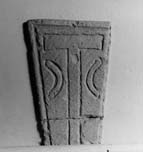
Object type: Grave-cover
Measurements: H. 70 cm (27.1 in); W. 32 > 22 cm (12.6 > 8.7 in); D. (visible) 2 cm (0.8 in)
Stone type: Yellowish orange (10YR 8/6) shelly sparry oolite. Film over surface makes it very difficult to see mineralogy and texture. Probably White Limestone Formation, Great Oolite Group, Middle Jurassic.
Plate numbers in printed volume: Ill. 450
Corpus volume reference: Vol 10 p. 254-5
(There may be more views or larger images available for this item. Click on the thumbnail image to view.)
This is one of a series of grave-covers set in the north aisle of the church. According to Rudd (1937, 180), these stones were all 'found in the roof of the aisle, cut up, reversed and utilized for gutters' during the restoration of 1860–2. No supporting documentation has been traced (see comments under Bisley 6 below, Appendix K, p. 381).
Tapering gravestone with a large Tau cross flanked by two outward curving shapes. The stone is bordered on two sides by a wide, slightly concave pseudo-moulding, the inside edge of which is defined by a round-bottomed groove. The moulding on the right side has been cut off.
Appendix A item (stones dating from Saxo-Norman overlap period or of uncertain date).
It has been suggested (MacKay 1963, 91, pl. VII, 16) that the two curving shapes are degraded alpha and omega symbols, and that they are to be likened to two similar shapes on a small headstone from Edgeworth (no. 2, Ill. 241). However, the Edgeworth shapes are probably intended to be paired birds, and these Bisley shapes are surely coffin handles. The Tau form of cross is not widely used in Anglo-Saxon carving, but two fine early eleventh-century Anglo-Saxon Tau crosses, carved from walrus ivory, have survived. One comes from Alcester in Warwickshire (see Ill. 782) and the other is now on display in the sacrarium of the church of Neu-St Heribert, Deutz, a 'suburb' of Cologne on the eastern bank of the Rhine (Beckwith 1972, 52, 124, ills. 65, 66, 81, 82; Hare 2000, 276). It is difficult to date this stone. It does not display any of the diagnostic features associated with other early eleventh-century gravestones from the area and the shape is also similar to several later gravestones in the church. Therefore, while the stone could belong to the early eleventh century, it could equally be of a later date.
