Select a site alphabetically from the choices shown in the box below. Alternatively, browse sculptural examples using the Forward/Back buttons.
Chapters for this volume, along with copies of original in-text images, are available here.


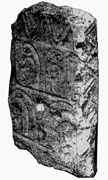
Object type: Part of grave-cover
Measurements: Length given in the newspaper article: c. 76 cm (c. 30 in); other dimensions unknown
Stone type: Unknown, but almost certainly oolitic limestone
Plate numbers in printed volume: Ill. 451
Corpus volume reference: Vol 10 p. 255-6
(There may be more views or larger images available for this item. Click on the thumbnail image to view.)
Part of a grave-cover or the top of a tomb. A photograph of the carving was published in the newspaper report mentioned above and the following details are drawn from this image.
A (broad): The face is divided into panels by horizontal mouldings. (i) The uppermost panel (across one end of the grave-cover) carries V-shaped zig-zag ornament with median grooves. (ii) In the centre of the next panel there are two tall, slender mouldings that curve away from each other as they rise. On the left the top of the moulding widens into a rounded terminal that is split horizontally by a lentoid shape. The top of the right-hand moulding is more wedge-shaped and terminates in a tight roll. On either side of the two central elements the face of the panel is covered with swirls of complex, but unintelligible, carving. (iii) On the third panel there are also two tall central motifs that curve away from each other as they rise, but each consists of a wide moulding divided into two by an incised groove. On the left the curve of the moulding is gentle and terminates in a rounded shape, in the centre of which there is an elliptical 'eye'. On the right the moulding narrows as it curves out and down in a tight sweep towards the edge of the stone, and the surface is textured and outlined with plain borders. As with the previous panel, the rest of the face is covered with complex, but unintelligible carving. (iv) The upper part of a fourth panel survives but very little of the carved detail.
B, D and E (narrow): The side face visible in the photograph (face B) carries V-shaped zig-zag ornament with median grooves, carved with sharper angles that the otherwise similar design in the upper panel of face A. The newspaper report (Walrond 1964) notes that this decoration occurred 'on three edges of the stone', which must mean that face D and possibly face E carried similar carving.
Appendix A item (stones dating from Saxo-Norman overlap period or of uncertain date).
The tall, curving mouldings in two of the panels on face A might be stylised birds or animals, as first suggested by Walrond in 1964. Indeed the carving in the lower of these panels might depict a peacock (a Christian symbol of immortality) in profile with its head to the left and fanned tail to the right. However, the present author believes that the shapes are more plant-like, rising and spreading out in stiff-leaved fans similar to the foliage on the capitals at St Mary's, Bibury in Gloucestershire (Bibury St Mary 8 and 9, Ills. 43–4). The Bibury capitals are dated to the first half of the eleventh century.
The continuous V-shaped or zig-zag decoration on face B might be compared to chevron, but it is more like the decoration along one edge of another carved stone from Bibury (St Mary 5, Ill. 40, also dated to the first half of the eleventh century). Derek Craig (pers. comm.) drew my attention to the use of a similar pattern across the top of the eleventh-century grave-marker from Otley in western Yorkshire, and on the fragment of a tenth-century recumbent monument (Ormesby 3) from northern Yorkshire (Coatsworth 2008, 226–7, ill. 606; Lang 2001, 189, ill. 716). A simpler version of the design is used on both narrow faces of an eleventh-century cross-shaft from Harmston in Lincolnshire (Everson and Stocker 1999, 176–7, ills. 196, 198). Bailey suggested that such decorations could be stone skeuomorphs of metalwork ornamentation (Bailey 1996b, 38–41, 45–6, figs. 5, 6). Early examples include an eighth-century cross-shaft fragment (Northallerton 1) from northern Yorkshire and an eighth-century cross-head fragment (Jarrow 9) from Co. Durham (Lang 2001, 181–2, ill. 662; Cramp 1984, 109, pl. 93.497). In some cases the design might also represent the tasselled edging to a decorated textile covering (Bailey 1996b, 37–8, fig. 4).
