Select a site alphabetically from the choices shown in the box below. Alternatively, browse sculptural examples using the Forward/Back buttons.
Chapters for this volume, along with copies of original in-text images, are available here.


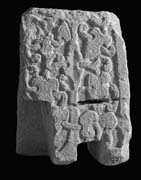
Object type: Part of cross-shaft
Measurements: H. 56 cm (22 in); W. 41 > 36 cm (16.1 > 14.2 in); D. 34 > 26 cm (13.4 > 10.2 in).
Stone type: Very pale orange (10YR 8/2), matrix-supported, shelly oolite. The ooliths, most of which have fallen out to give an 'aero-chocolate' texture, range from 0.3 to 0.5 mm, but are mostly between 0.4 and 0.5 mm and set in a sparry matrix; they form about 50% of the rock. There are common sub-rounded and platy shell fragments up to 3 mm across forming about 10–15% of the rock. Cleeve Cloud Member, Birdlip Formation, Inferior Oolite Group, Jurassic. The nearest outcrop of Birdlip Limestone is south and west of Chipping Camden, some 20 km to the south.
Plate numbers in printed volume: Ills. 582-4; Fig. 30F
Corpus volume reference: Vol 10 p. 335-6
(There may be more views or larger images available for this item. Click on the thumbnail image to view.)
The first record of the stone is as part of the exterior filling of the vestry west doorway, with only the side with the Christ exposed; the stone was noted in this position by Styles (1945, 61). Removed for better preservation and display in 1981 (Morris 1983; id. 1996, 9).
Cross-shaft, with evidence of multiple reuse. One face of the shaft was re-carved in the twelfth century (see below). The stone was subsequently rebated on faces B and C, perhaps for use as a doorjamb. A large socket has also been cut into the lower corner of faces D and A, and a square-sided slot had been cut across face F (the base) from face A to face C. There is also a narrow wear-slot that runs horizontally across face A. When first recorded (see above) the stone was being reused yet again as part of a door jamb with face D, the twelfth-century re-carved face, facing outwards.
A (broad): Carved with a tree-scroll in fairly high relief with a plain square edge moulding. The straight central stem curves up from a plain edge moulding at the base of the stone and branches into two at the top. The central portion of the stem is split open and pealed back as if to expose the inside. Median-incised side shoots pierce the pealed-back walls and curve across the face of the stone to end in curving tendrils and large, flat, heart-shaped leaves. Further side shoots, which also end in large leaves, cross over or under the central stem, and curve down from the two branches at the top of the stone. The leaves themselves are outlined with fine incised lines and are pierced with further curling-tipped tendrils.
B (narrow): Covered by a pattern of lozenges in shallow relief that look like roof tiles or Roman-style opus reticulatum. The face has a broad, flat, pseudo-moulding on the left side and across the bottom, and the remains of what is probably a panel-dividing border across the top. The inside edge of the pseudo-moulding is defined by a round-bottomed groove.
C (broad): None of the carving survives on this face.
D (narrow): This face is dominated by the standing figure of Christ. He faces forward and has a rather round head with wide eyes that have shallow, probably drilled, pupils. The nose is quite broad, the mouth is partly open and he has a small beard. The hair is short and the ears small. Behind his head there is a badly damaged, but clearly cruciform, halo. Christ holds a long-staffed cross in his right hand, while with his left hand he pulls up a second figure below. Christ is caught in movement with his left leg straight and his right leg bent at the knee, and the right foot on higher 'ground' than the left. He wears a full-length, long-sleeved tunic, the upper part of which is tight and quilted while the skirts fall in heavy, overlapping folds. A belt is loosely tied around his hips. The belt's broad flat terminals curve down across his lower body. Most of the second figure has been cut away by the later socket, but enough remains to show that both arms are raised. The head is large and round, the ears small. All the facial features have been lost, but there is a small halo behind the head.
This is a very unusual piece in that one face (face D) of this tenth-century cross has been re-carved in the twelfth century with what is almost certainly a Harrowing of Hell, although it has also been suggested that this carving might depict Doubting Thomas (Ill. 584). Morris has drawn attention to the similarity of the figure to that of the man on a twelfth-century tympanum also found reused in the church, in particular in the treatment of the folds of the sleeves, and he has suggested that both are likely to be by the same sculptor, who can be identified as one of the leading artists of the Herefordshire school (Morris 1996).
The pierced, spade-shaped leaves and curling-tipped tendrils that wrap around and pass through the central stem on face A have tenth-century parallels, for example at Colyton in Devon (Cramp 2006, 80–2, 163–4, ill. 4). Closely related motifs can be found on Gloucester St Oswald 15 (Ills. 316–19). One panel on the Abingdon sword has leaves penetrated by plant-stems (Backhouse et al. 1984, 34, ill. 14a). The peeled-back portion of the main stem is perhaps an attempt to show the Tree of Life bearing the wounds of Christ.
The pattern of overlapping lozenges on face B is a design unique to the area and it is difficult to interpret. It could simply be geometric ornament like the chequer-board panel on one face of the Bewcastle cross, but it is somewhat reminiscent of the tiled 'roofs' of some northern hogbacks and the stepped-triangle motif on a grave-marker from Winchester (Cramp 1991, xxi, fig. 7; Tweddle et al. 1995, 276, ill. 495). A similar panel of lozenges occurs across the top of a later, overlap-period tympanum from Haltham-on-Bain, Lincolnshire (Everson and Stocker 1999, 311, ill. 494). Alternatively, if the design is not based on tiles but on Roman decorative opus reticulatum work as suggested above, then this panel might have a more subtle meaning, perhaps a representation of the wall of a shrine.
