Select a site alphabetically from the choices shown in the box below. Alternatively, browse sculptural examples using the Forward/Back buttons.
Chapters for this volume, along with copies of original in-text images, are available here.


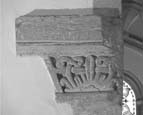
Object type: Capital
Measurements: H. overall 59 cm (23.2 in); capital 32 cm (12.6 in); abacus 27 cm (10.6 in); W. (north–south) abacus 72 cm (28.3 in); capital 55 > 44 cm (21.6 > 17.3 in); D. (east–west) 87.5 cm (34.4 in)
Stone type: Yellowish grey (5Y 7/2), matrix-supported, micritic shelly oolite. Ooliths 0.3 to 0.5 mm across; they form about 75% of the stone. Most ooliths have fallen or weathered out to give an 'aero-chocolate' texture. Scattered shell fragments up to 2 mm form less than 1% of the stone. Farmington Freestone?, Taynton Limestone Formation?, Great Oolite Group, Jurassic.
Plate numbers in printed volume: Ill. 44; Fig. 22A
Corpus volume reference: Vol 10 p. 141
(There may be more views or larger images available for this item. Click on the thumbnail image to view.)
Trapezoidal capital with southern side cut back to a vertical edge. The capital is carved on western face with foliate decoration rising from a broad border and with a border running up the northern, sloping side. The carved face shows a central, fleshy vertical leaf flanked by small shoots and long curving shoots that become twisting tendrils near the top of the stone. A horizontal cross-bar divides the carved face into two zones. The capital is surmounted by a wide projecting abacus, square-faced with an inward chamfer on the lower face. A narrow V-shaped groove accentuates the top of the chamfered face. Both capital and abacus are through-stones.
See Bibury 8.
