Select a site alphabetically from the choices shown in the box below. Alternatively, browse sculptural examples using the Forward/Back buttons.
Chapters for this volume, along with copies of original in-text images, are available here.


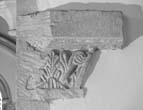
Object type: Capital
Measurements: H. overall 59 > 58 cm (23.2 > 22.8 in); capital 34 > 33 cm (13.4 > 13 in); abacus 25 cm (9.8 in); W. (north–south) abacus 72.5 cm (28.5 in); capital 53 > 44 cm (20.9 > 17.3 in); D. (east–west) 87 cm (34.2 in)
Stone type: Side only accessible, but covered in a plaster wash. Could not get close enough for a detailed examination. Yellowish grey (5Y 7/2), micritic shelly oolite. Ardley Member? White Limestone Formation, Great Oolite Group, Jurassic.
Plate numbers in printed volume: Ill. 43; Fig. 22B
Corpus volume reference: Vol 10 p. 140
(There may be more views or larger images available for this item. Click on the thumbnail image to view.)
Trapezoidal capital with northern side cut back to a vertical edge. The capital is carved on western face with 'acanthus' foliate decoration rising from a square-section border and with a narrow border running up the southern, sloping side. The capital is surmounted by a wide projecting abacus, square-faced with an inward chamfer on the lower face. Both capital and abacus are through-stones.
Zarnecki believed that the two chancel arch capitals at Bibury (nos. 8 and 9) were carved in the middle of the eleventh century, but that they were 'conceived as flat, two-dimensional compositions [which] owe nothing to the classical traditions that so frequently inspired the decoration of capitals in the first half of the 11th century in other parts of Western Europe. [Instead] the appearance of the capitals points ... to manuscript decoration as the source of their inspiration', and specifically to 'the vigorous acanthus pattern employed by Anglo-Saxon artists of the so-called Winchester School' (Zarnecki 1955, 211, pls. 152–3). These observations led Zarnecki to declare that the Bibury capitals are 'the oldest surviving sculptures which can be claimed to have been inspired by the Winchester acanthus'.Parallels for the decoration on both capitals can also be found in an illuminated psalter, of late tenth- or very early eleventh-century date, once associated with Winchcombe Abbey in Gloucestershire (Cambridge, Univ. Lib. MS Ff. I. 23, fols. 4v, 5, 171: Temple 1976, 97–8, cat. 80, ills. 249, 250, 253). More recent scholarship has tended to call this manuscript the Cambridge Psalter, with Lapidge arguing that it 'comes from the circle of Abbot Germanus, perhaps written in Ramsey', and Dumville suggesting that the manuscript was written in Canterbury or Cholsey (Lapidge 1993, 388–91, 414–17; Dumville 1991–5, 40–1).
