Select a site alphabetically from the choices shown in the box below. Alternatively, browse sculptural examples using the Forward/Back buttons.
Chapters for this volume, along with copies of original in-text images, are available here.


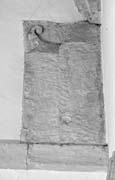
Object type: Carved panel
Measurements: H. c. 110 cm (43.2 in), W. c. 70 cm (27.5 in); D. unknown
Stone type: Oolitic limestone, too high for detailed examination
Plate numbers in printed volume: Ill. 42; Fig. 31M
Corpus volume reference: Vol 10 p. 139-40
(There may be more views or larger images available for this item. Click on the thumbnail image to view.)
The panel is roughly rectangular and appears to be complete. It rests on a square sectioned string-course, the bottom of which is c. 6 m (c. 20 ft) above the present nave floor. The carving depicts a two-cell building, the right part being higher than the left. Both parts of the building have steeply sloping roofs, that on the left rising to an elaborate foliate finial. All other surfaces on this fictive building have been heavily cut-back. However, it is still possible to make out the remains of a pilaster, perhaps with a stepped base, on the left corner of the building, while on the right, one can trace the outline of two edging pilasters supporting a cut-back, round-headed arch.
The appearance of a building is fairly unusual in Anglo-Saxon carving, and suggests that whatever was depicted on this wall was not a standard rood. This building could represent the Temple, but there is no obvious sign of the Temple curtain being split in two that is associated with the death of Christ. The building could also be a formal interpretation of the Tomb, but again there are none of the normally associated features. Instead, this seems to be part of a narrative scene.
Buildings are frequently present in manuscript illustrations where they are associated with representations of many biblical events, such as God's calling of Abraham out of Haran after his family had left the city of Ur. The New Testament offers 'building-related' episodes from all the stages of Christ's life from the Nativity and the Presentation in the Temple, to the triumphal entry into Jerusalem. Buildings are also shown in some representations of the Heavenly Kingdom. On fol. 38v of the Cambridge Corpus Christi MS 23 (an illustrated copy of Prudentius' Psychomachia) there is a representation of 'The Temple built by the Virtues', on the gable of which is a very similar foliate finial. This manuscript has additions made at or for Malmesbury Abbey in 1033–44, but may be late tenth century in origin (Budny 1997, 432–3, ill. 284).
Buildings are also found on Anglo-Saxon ivory carvings such as the St Lawrence Box, where a towered building rises behind one of the figures (Beckwith 1972, cat. 19, ills. 42–5). Small, two-storey buildings appear on a late tenth-century Anglo-Saxon ivory depicting the Transfiguration, where they represent the tabernacles or dwellings that Peter proposes to build for Jesus, Moses and Elijah (ibid., cat. 21, ills. 49, 51). In continental Europe, a panel from Metz, dated to the beginning of the tenth century, shows Christ's triumphal entry into Jerusalem above a second scene in which a woman (sometimes identified as Mary Magdelene) washes and annoints Christ's feet as he sits with his apostles in the house of Simon (Willianson 2010, 197, cat. 48). In the lower scene on this panel, Christ is depicted in front of a small, two-storey building that is very similar to the tabernacles on the Anglo-Saxon Tranfiguration panel mentioned above. This might be a representation of the woman's similar desire to offer protection to the Lord, but in this context, the bulding might instead represent a pre-figuring of the Tomb. Buildings are also depicted on several of the surviving ivory panels from a large group associated with Magdeburg Cathedral. The panels were probably carved in northern Italy (perhaps Milan) and are dated to c. 968. It is suggested that they once decorated an altar frontal, an ambo or a bishop's throne in the cathedral (Fillitz 2001, 362–80, ills.). On one panel (V.35a) a two-cell building (Magdeburg Cathedral) is presented to Christ in Majesty for his blessing. On another panel (V.35c) the twelve-year-old Christ is shown seated in the Temple, with Joseph and Mary. Again the building is a two-cell structure, but in this case one can see into the building through a high arch that is open to the floor. Before it was cut-back, the high arch in the front wall of the carved Bibury building would have created a very similar feature, and perhaps here too the viewer was being encouraged to see or step inside.
