Select a site alphabetically from the choices shown in the box below. Alternatively, browse sculptural examples using the Forward/Back buttons.
Chapters for this volume, along with copies of original in-text images, are available here.


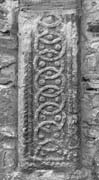
Object type: Grave-cover or decorated jamb
Measurements: H. 90 cm (35.4 in); W. 36.5 > 36 cm (14.3 > 14.1 in); D. max. visible 10 cm (3.93 in)
Stone type: Yellowish grey (5Y7/2), poorly sorted, matrix-supported, sparry, shelly, oolite. Ooliths are in the range 0.2 to 0.6 mm and form some 50 to 60% of the stone; most have fallen or weathered out to give an 'aero-chocolate' texture. Scattered, sub-rounded, platy shell fragments (including bryozoa) up to 5 mm form some 15 to 20% of stone. Ardley Member? White Limestone Formation, Great Oolite Group, Middle Jurassic.
Plate numbers in printed volume: Ill. 40; Fig. 18J
Corpus volume reference: Vol 10 p. 138
(There may be more views or larger images available for this item. Click on the thumbnail image to view.)
None. Noted in its present position by Keyser (1918–19, 188). Verey (1976, 91) describes this stone as 'one of a number found near the church in 1913' and it has recently been stated that the stone was reset in this position c. 1913 (Verey and Brooks 1999, 167). It seems more probable that the stone was set in this position at an earlier date, since a letter from the incumbent to the British Museum dated 29 January 1913 mentions that 'There is still one other stone built into the Wall' (correspondence in British Library, A/45/147/764); the reference is presumably to Bibury 5.
Only one face is visible. A panel of interlocking circles with large, flat-faced pellets, within a double border that consists of a continuous row of pelleting outside a simple moulding.
The stone has been identified as a grave-cover, but it is too narrow. It could, however, be the centre part of a chamfered grave-cover (like Bisley All Saints 1, Ills. 45–9) with the chamfers cut back to form straight sides. It is equally possible that the stone was originally part of the decorated facing on the jamb of an opening.
