Select a site alphabetically from the choices shown in the box below. Alternatively, browse sculptural examples using the Forward/Back buttons.
Chapters for this volume, along with copies of original in-text images, are available here.


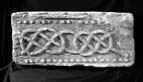
Object type: Incomplete grave-cover
Measurements: L. 82 cm (32.2 in); W. 35 cm (13.8 in); D. 25 > 24 cm (9.8 > 9.4 in)
Stone type: Very pale orange (10YR 8/2), matrix-supported, shelly oolite. Ooliths, 0.3 to 0.7 mm diameter, but mostly in the range 0.4 to 0.5 mm, constitute about 40% of the rock. Most ooliths have fallen or weathered out to give an 'aero-chocolate' texture. Shell fragments, mostly sub-rounded up to 5 mm across, but with a few platy fragments, constitute about 30% of the rock. Ardley Member? White Limestone Formation, Great Oolite Group, Jurassic.
Plate numbers in printed volume: Ills. 35-9
Corpus volume reference: Vol 10 p. 137-8
(There may be more views or larger images available for this item. Click on the thumbnail image to view.)
Incomplete grave-cover with interlace and border of pellets. This rectangular slab is carved on the upper face and one side. The surface of the stone is damaged at one end, and the carving on the upper face once continued onto a second stone, or the stone has been cut.
A (top): The upper face carries a plain narrow edge moulding and a continuous row of dome-headed pellets down each side. Within the pelleting is a loose-looped, closed-circuit, simple pattern F interlace (Cramp 1991, fig. 23). The strands are half-round in profile, and the pattern continues beyond the stone at one end. There is an in-turning side shoot with curling tip at this end, and there are traces of what is probably a second curling-tipped side shoot in one corner at the other end.
B (long): Side face with double row of arcading. Upper arcade consists of a continuous raised, half-round moulding carved in a series of scallops or semi-circular arches separated by simple imposts. The lower row consists of raised, semi-circular headed solid panels.
C (end): Fine-tooled, probably a jointing face between this and a second stone.
D (long): Side plain with heavy diagonal tooling. This may be original tooling.
E (end): Coarsely tooled and now broken.
F (bottom): Back plain with fine tooling and a smoothed surface. As on face D, this may be the original finish.
This is probably part of a grave-slab that consisted of more than one stone. The slab was designed to be seen from the top and front, and may, therefore, have been set in a niche. The interlace is delicate, like that found on some metalwork examples, and seems to float in the centre of the panel. A rather similar, if more robust, stone is set upright in a pilaster on the external face of the north wall of the north aisle (Bibury 5, Ill. 40). An alternative interpretation could be that both stones should be seen as architectural pieces, perhaps from the jambs of openings.
Bibury was a minster established on episcopal land (Tinti 2010, 207–9). The first formal record dates from 899, when an episcopal lease reserved church-scot and soul-scot to Bibury (Sawyer 1968, no. 1279). However, the minster had probably been established in the first half of the eighth century by Beage, daughter of Leppa, who is mentioned in a lease of Bishop Wilfrith of Worcester (718–743x5) (Sawyer 1968, no. 1254); the settlement takes its name from her (Sims-Williams 1990, 93 n. 24, 152). There is no evidence relating to Bibury during the late Anglo-Saxon period (to which all the sculpture belongs), but Bibury was still in episcopal hands at the time of the Domesday Survey; a single priest is recorded with the substantial holding of 3 hides (Moore 1982, no. 3, 4; see also Blair 1988b, 11–12).
