Select a site alphabetically from the choices shown in the box below. Alternatively, browse sculptural examples using the Forward/Back buttons.
Chapters for this volume, along with copies of original in-text images, are available here.


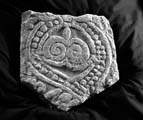
Object type: Part of grave-marker
Measurements: H. max. 35 cm (13.8 in); W. 34 > 31.5 cm (13.4 > 12.4 in); D. 5.6 cm (2.2 in)
Stone type: Very pale orange (10YR 8/2), shelly, matrix-supported oolite. Ooliths range from 0.2 to 0.6 mm diameter, but are mostly in the range 0.3 to 0.6 mm. Most ooliths have fallen or weathered out to give an 'aero-chocolate' texture; they form about 45% of the rock. Platy to sub-rounded shell fragments, including cidarid spines, up to 6 mm across, form about 30% of the rock; in places they are concentrated into bands where they form about 40% of the rock. Ardley Member? White Limestone Formation, Great Oolite Group, Jurassic.
Plate numbers in printed volume: Ills. 29-32; Fig. 29F
Corpus volume reference: Vol 10 p. 136-7
(There may be more views or larger images available for this item. Click on the thumbnail image to view.)
Double-sided grave-marker, broken at both ends, with decoration on two faces. The stone tapers and should be viewed with the flatter broken end at the top and the pointed end at the bottom.
A (broad): Two broad, curving bands of decoration dominate this face. Lobed leaves fill the background. The bands of decoration are outlined on the inside and the outside with simple mouldings and filled with flat-faced pellets. The bands interlace where they pass over one another, and beyond this crossing point the fill changes to a single large pellet and then hollow-centred crescent shapes. The inner moulding is split about halfway down the stone. Part of the moulding curves inwards to support a pair of spiral volutes, from the centre of which springs a single leaf. The other part of the inner moulding twists outwards to form a crescent-shaped curve across the pellet infill. The decoration at the flatter end of the stone has been badly damaged, but it is still possible to see that this complex, almost horizontal area of interlocking curves is linked by two straps that cross the main bands of decoration.
B and D (narrow): Both faces are coarsely dressed with secondary tooling.
C (broad): Covered with median-incised, flat-faced mouldings in intersecting arcs and ovals that are outlined and filled with round-headed pellets.
The decoration on face A of this grave-marker is perhaps a pair of animal bodies, similar to Bibury 1 (Ill. 27) and also to the fragment from Somerford Keynes (no. 1, Ills. 426–7). The complex area of carving at the top of the stone may be the remains of the heads of such creatures, and the crescent-shaped infill could be body scales. The extensive use of pelleting on this stone is not a common feature in the western Midlands. It is, however, found on several other carvings from the immediate area (Bibury 4 and 5, Broadwell 1; Ills. 35, 40, 87) where it is used as infill and as bordering. Pelleting is also part of the design of the Ringerike-influenced grave-marker from Bibury (no. 1) and it seems probable that this small group of carvings, together with Somerford Keynes 1, is the work of a group of craftsmen perhaps working for a Danish patron (see Chapter VII, p. 81). Pelleting is also used to decorate imposts at the Cotswold churches of Coln Rogers (nos. 1, 2) and Daglingworth (nos. 5, 6), and the possibly rather later fragments of a grave-cover from Bisley (Bisley Parish 2, 3).
Rice acknowledged that Bibury 1 and Somerford Keynes 1 owed much of their character to metalwork exemplars (Rice 1952a, 129; see also no. 1 above), and this is probably true of the other carvings in this group. Hawkes has similarly acknowledged the influence of metalworking techniques upon earlier west Mercian carvings at the Sandbach crosses in Cheshire (Hawkes 2001, 236–8). This being so, and with the possibility of a Danish patron in mind, the pelleting could be seen as the translation into stone of the gold granulation found on some Viking jewellery, for example a group of brooches and pendants from Hedeby (Graham-Campbell and Kidd 1980, 146, ill. 84).
Double-sided grave-markers are not exactly common, although they occur over most of Anglo-Saxon England. In the wider study area there are three more examples, all from Shropshire (Shrewsbury St Mary 1, 2 and Diddlebury 3; Ills. 548–52, 577–8). Elsewhere double-sided grave-markers can be found for example in Lincolnshire (Gaydon-le-Wold 1 and Hackthorn 2), north Yorkshire (Lythe 10–15) and Hampshire (Winchester Old Minster 92) (Everson and Stocker 1999, 167, 175, ills. 180–4, 190–4; Lang 2001, 157–8, ills. 499–531; Tweddle et al. 1995, 337, ills. 691–4).
