Select a site alphabetically from the choices shown in the box below. Alternatively, browse sculptural examples using the Forward/Back buttons.
Chapters for this volume, along with copies of original in-text images, are available here.


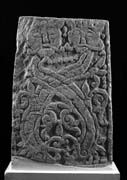
Object type: Incomplete grave-marker
Measurements: H. 65 > 64 cm (25.6 > 25.1 in); W. 44.5 > 38 cm (17.5 > 14.9 in); D. 9 cm (3.5 in)
Stone type: Very pale orange (10YR 8/2), shelly, matrix-supported oolite. Ooliths range from 0.2 to 0.6 mm diameter, but are mostly in the range 0.4 to 0.5 mm; and set in a sparry matrix. Most ooliths have fallen or weathered out to give an 'aero-chocolate' texture; they form about 40–50% of the rock. Platy shell fragments up to 5 mm are common and form 25–30% of the rock. Ardley Member? White Limestone Formation, Great Oolite Group, Jurassic.
Plate numbers in printed volume: Ills. 27-8; Fig. 29G
Corpus volume reference: Vol 10 p. 134-6
(There may be more views or larger images available for this item. Click on the thumbnail image to view.)
None. It is evident that the provenance of this item and of Bibury 2, 3 and 4 was unclear at the time when they were transferred to the British Museum in 1913. Smith (1913–14a, 61) comments that the 'carvings came to light a few years ago in the churchyard'; his further statement that the stones 'lay near the surface in the angle between the tower and south wall of the nave' has no value, for the tower is at the west end of the north aisle. A letter dated 11 December 1912 from the incumbent, the Hon. and Revd. F. G. Dutton, to Sir Hercules Read commented that he believed that the sculptures 'came out of the East Wall of the South aisle when we had in 1896 to rebuild that wall', but in a subsequent letter dated 8 January 1913 he withdrew this remark; according to information provided by the parish clerk, the stones 'were always lying against it [the east wall of the south aisle]' (correspondence in British Library, A/45/147/764). The revised information followed a vestry meeting on the previous day, 7 January, at which time it was stated that the stones 'had been lying in the churchyard but had since the partial restoration of the Church in 1896 been removed into the Tower' (Gloucestershire Archives, P44 VE 2/1). It is possible that the stones came to light during earlier restorations in 1855 and 1862–3 (Verey and Brooks 1999); these earlier restorations are not well documented.
Grave-marker, broken a little at the base, with a pair of interlaced, double-ended creatures.
A (broad): Within a simple flat border, the stone bears a pair of double-ended creatures, the bodies of which interlace where they cross. The edge mouldings of the creatures' bodies curve outwards and inwards at various points, becoming tendrils, buds and lobed leaves. At the top the creatures have heart-shaped humanoid faces with wide, curling moustaches, pointed ears and crests across the top of their heads. They have broad noses and large, vacant eyes. A row of pellets underlines the two heads. The lower heads of the creatures oppose one another face to face. In each case the junction between the jaws and the face is outlined by a lappet which hangs down below the head and terminates in a curling tip. The eyes are round. The tips of the creatures' lower lips touch one another, and there are pairs of large fangs in the open jaws. The ears are leaf-shaped and point backwards, and the heads carry elaborate, curling-tipped combs or crests.
B and D (narrow): The edges are coarsely tooled.
C (broad): Covered with coarse, round-bottomed tooling in irregular patterns.
This grave-marker is a fine example of the absorption of new ideas by Anglo-Saxon carvers, in this case the Ringerike style from Norway. The carving of the two-headed, figure-of-eight beasts carries much of the idiosincratic energy of the original carvings and metalwork, but without what Kendrick called the 'extravagant savagery' of examples such as the creatures on the Heggen vane (Kendrick 1949, 102, pl. LXX 2; Campbell et al. 1982, 198, fig. 174). The foliate elements of the design are also gentler, less agitated, and similar to leaf-forms seen in Anglo-Saxon manuscripts dated to the first half of the eleventh century such as the Bury Gospel (British Library, MS Harley 76: Kendrick 1949, pl. LXXI.2–3; Temple 1976, 93, cat. 75) and the British Library psalter, MS Stowe 2 (Temple 1976, 117–18, cat. 99, ill. 296). The heads of the lower creatures on the Bibury stone are like the head of the great beast on the eleventh-century grave-marker from St Paul's, London (Tweddle et al. 1995, 226–8, ill. 351). The Bibury creatures are also similar to those on a fragment from Somerford Keynes (no. 1, Ills. 426–7), and both of these monuments, associated with churches that are little more than ten miles apart, may indeed be the work of the same carvers. The upper heads on the Bibury stone are probably lions, and what look like luxurious moustaches are actually the creatures' upper lips, as can be clearly seen in the 'Beatus' intitial (fol. 1) of British Library MS Stowe 2 mentioned above. All these similarities led Kendrick to suggest that we should 'accept the Bibury carving as bearing an English design vaguely altered in the direction of the fluttering disorder of Ringerike art' (Kendrick 1949, 102–3).
The Ringerike creature on the bronze Heggen vane has been mentioned above, and Rice acknowledged that Bibury 1 and Somerford Keynes 1 probably owed much of their character to metalwork exemplars (Rice 1952a, 129). It seems probable that gold granulation, used to enhance much Anglo-Saxon and Viking jewellery, was also the ultimate source for the pelleting that appears on Bibury 1 and even more extensively on Bibury 2 and other carvings from the area (see also no. 2 below).
