Select a site alphabetically from the choices shown in the box below. Alternatively, browse sculptural examples using the Forward/Back buttons.
Chapters for this volume, along with copies of original in-text images, are available here.


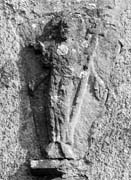
Object type: Large panel with figure of Christ
Measurements:
H. (excluding supporting plinth) c. 116.5 cm (45.8 in); W. across top of panel c. 81 cm (31.8 in); across bottom of panel 32 cm (12.6 in); D. of backing panel (ascertained by probing) c. 8 cm (3.1 in); of carving 11–13 cm (4.3–5.1 in)
Supporting plinth: H. 13 cm (5.1 in); W. 42 cm (16.5 in); D. c.12 cm (4.7 in)
Stone type: Unable with ladder available to get closer than 1 m to the stone, but it appears to be a greyish orange (10YR 7/4) rather shelly oolite with shell debris up to 1 cm in size. Lamination picked out by shell debris lies at an acute angle to the slab. Possibly Forest Marble Formation, Great Oolite Group, Middle Jurassic.
Plate numbers in printed volume: Ills. 25-6; Fig. 32E
Corpus volume reference: Vol 10 p. 133-4
(There may be more views or larger images available for this item. Click on the thumbnail image to view.)
Original position unknown. Bigland (1791, 250) comments as follows in his account of Beverstone church, 'To the South Wall of the Tower is affixed, on the Outside, a Figure in Relief of an Ecclesiastic holding a Crosier, which appears to have been a sepulchral Monument'. Although the description is inaccurate, Bigland's account clearly refers to this item and indicates that it was in its present position in the late eighteenth century.
A large wedge-shaped panel depicting Christ, with his right hand raised in blessing and the left hand holding a long-shafted, processional cross. Christ's right hand is not only raised but also twisted to the right. The first two fingers are held out together in blessing and the thumb is slightly raised. The face is square-jawed, possibly bearded, but no facial features survive. The head is tilted slightly to the left. The hair is long and falls down onto the shoulders on either side of the neck. Behind the head is a large cruciform halo that rests on the figure's shoulders. The body is clothed in a long, ankle-length tunic with deep vertical folds. Some traces of an over-garment may survive, although some of the surface 'rippling' across the lower body is probably the result of weathering along the edges of the stone's natural laminates. On either side of the figure delicate draperies fly out as if caught on the breeze. The figure's feet point outwards and downwards and are set on a sloping surface that is presumably intended to be the ground.
This figure of Christ, with flying drapery and carefully modelled folds on the clothing, is a good example of the style sometimes called the 'Winchester School' that was widespread in England in the tenth century. It is suggested that the Beverstone panel should be dated to the second half of the tenth century.
The figure is set into the south face of the twelfth-century tower and is, therefore, clearly not in its original position. The backing stone is wedge-shaped and the figure is very carefully placed within this unusual frame. There is no indication that the backing stone has been recut to its present shape: no setting-out lines for a recut, and none of the image has been lost — even the tips of the flying drapery are complete. Instead the carving seems to take the form of an enlarged key-stone, and the sculpture was perhaps designed to be set in or directly above the chancel arch of an earlier church on the site. A similar figure was discovered in 1993, painted onto a high-level panel at St Mary's Church, Deerhurst in Gloucestershire (Bagshaw et al. 2006; see Deerhurst St Mary 7, this volume).
The Beverstone figure is Christ Triumphant or Christ in Majesty (see Chapter VIII, p. 92). He stands on earth again at the Second Coming, calling the faithful to him and offering God's blessings through the Water of Life:
'See I am coming soon; my reward is with me, to repay according to everyone's works. I am the Alpha and Omega, the first and the last, the beginning and the end. It is I, Jesus, who sent my angel to you with this testimony for the churches. I am the root and descendant of David, the bright morning star. Let everyone who is thirsty come. Let anyone who wishes take the Water of Life as a gift' (Revelation: 22, 12–13, 16–17).Beverstone makes a fleeting, but significant, appearance in Anglo-Saxon history; it was at Beverstone that Earl Godwine assembled his forces in 1051 in his showdown with Edward the Confessor. In 1051 Gloucestershire was in the earldom of Godwine's eldest son, Swein, and had been since 1043 except when Swein was in exile; before 1043 Gloucestershire had possibly been in Godwine's own earldom (Baxter 2007, 304, 311 n. 111). This suggests at least the possibility that Beverstone was a comital manor, the high quality and the scale of the sculpture certainly suggest a patron of very high status.
