Select a site alphabetically from the choices shown in the box below. Alternatively, browse sculptural examples using the Forward/Back buttons.
Chapters for this volume, along with copies of original in-text images, are available here.


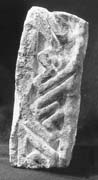
Object type: Fragment of carved hood-moulding
Measurements: H. 20.4 cm (8 in); W. 8.3 cm (3.3 in); D. 18.3 cm (7.2 in)
Stone type: Very pale orange (10YR 8/2) sparry matrix supported oolite. Ooliths range in size from 0.3 to 1.0 mm and most are hollow. Sparse shell debris up to 2 mm in size. Cleeve Cloud Member, Birdlip Limestone Formation, Inferior Oolite Group, Middle Jurassic.
Plate numbers in printed volume: Ills. 10-2; Fig. 18A
Corpus volume reference: Vol 10 p. 129
(There may be more views or larger images available for this item. Click on the thumbnail image to view.)
This stone was first observed in December 1970 from the north aisle roof by the Revd. Canon J. E. Gethyn-Jones; it was built into the clerestory wall of the nave. The stone was removed soon afterwards for safekeeping in the church (file of Gethyn-Jones press-cuttings, Berkeley Library).
A section of hood-moulding, decorated on the outer face with a well-carved key fret (Allen 1903, 327, 341, nos. 868, 929). The carved face is burned and weathered (indicating that the moulding was set externally). The sides of the stone are trimmed with a flat-bladed axe.
This section of key-fret decorated hood-moulding, together with the small fragment of an impost for an arch or doorway (Berkeley Castle 4, Ills. 21–4), indicates the presence of an early building on or near the site of the present parish church (see Berkeley Castle 4, p. 132, for further details).
