Select a site alphabetically from the choices shown in the box below. Alternatively, browse sculptural examples using the Forward/Back buttons.
Chapters for this volume, along with copies of original in-text images, are available here.


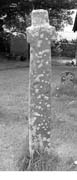
Object type: Short-arm cross
Measurements: H. 160 cm (62.9 in); W. (shaft) 16 > 21 cm (6. 3 > 8.3 in); (arms) 27 cm (10.6 in); D. c.18 > c.13 cm (7.1 > 5 in)
Stone type: Pale red (10R 6/2), non-calcareous, clast-supported, micaceous, dominantly fine-grained sandstone. The sub-angular to sub-rounded quartz grains vary from 0.1 to 0.3 mm, but are mostly 0.2 mm across. There are a few scattered white mica flakes. St Maughan's Formation? (Lower Old Red Sandstone Group, Old Red Sandstone Super Group), early Devonian age.
Plate numbers in printed volume: Ills. 514-16
Corpus volume reference: Vol 10 p. 289-90
(There may be more views or larger images available for this item. Click on the thumbnail image to view.)
In 1929 Watkins was informed by Mr George Marshall that in 1908 he had seen this cross lying in Llanveynoe churchyard; the stone was subsequently found and erected in its present position ((—) 1927–9, cviii–cix). Watkins also reported that he had been informed by the incumbent that the stone had been 'brought some years ago from a farm on the opposite side of the valley occupied by a Mrs Watkins, where it had been used as a water-gutter'. At a subsequent date Watkins discussed this cross with 'Mr Smith, of Olchon Court, now 77 years old', who informed him that when he was a boy, the stone was standing in the churchyard in a position similar to that in which it had recently been erected (Watkins 1930–2). Mr Smith also told Watkins that 'his father had told him that in old days, when burying at Clodock anyone dying in the Olchon Valley (Llanveynoe not being used for burials at that time), they always halted the cortege when they came opposite Llanveynoe Church, and carried the coffin round the cross in the churchyard, and without any service or prayer, out again and on down to the mother church for burial....' (Watkins 1930–2).
Cross (type A1) with short lateral arms. The rectangular shaft tapers from the bottom up. The lower edge of the cross-arms is picked out with a faint incised line below, while above the cross-arms the cross-head is stepped back slightly on the east face. The east, north and south faces of the cross are plain, while down the west face there is a gradually deepening groove that is presumably related to the reuse of the cross as a water-gutter at Mrs Watkins' farm (see above).
The shape of the cross was, presumably, constrained by the shape of the available stone. It is very similar to the tall, narrow slab-cross from Pontfaen in Pembrokeshire, dated ninth to eleventh century (Edwards 2007, 424). The highly ornate Neuadd Siarman pillar cross from Maesmynys, in Breconshire about 25 miles to the west of Llanveynoe (Redknap and Lewis 2007, 227–30), is also similarly constrained with very short cross-arms. Llanveynoe St Peter 3 is probably tenth/eleventh century in date, but there are no diagnostic features other than the constrained width that is common to many of the earlier Welsh stones due to natural jointing of the local sandstone.
