Select a site alphabetically from the choices shown in the box below. Alternatively, browse sculptural examples using the Forward/Back buttons.
Chapters for this volume, along with copies of original in-text images, are available here.


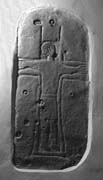
Object type: Crucifixion panel
Measurements: H. 125 cm (49.1 in); W. 56 cm (22 in); D. unknown
Stone type: Difficult to make accurate observations as there is virtually no fresh surface — pale red (5R 6/2), non-calcareous, clast-supported, micaceous, fine-grained sandstone. The sub-angular to sub-rounded quartz grains vary from 0.1 to 0.2 mm. St Maughan's Formation? (Lower Old Red Sandstone Group, Old Red Sandstone Super Group), early Devonian age.
Plate numbers in printed volume: Ills. 512-3; Fig. 31E
Corpus volume reference: Vol 10 p. 288-9
(There may be more views or larger images available for this item. Click on the thumbnail image to view.)
Like Llanveynoe St Peter 1, this stone was placed in its present position in 1912 and had previously been lying loose in the churchyard (Watkins 1927–9, 204). However, the circumstances of its discovery are even less clear. Watkins commented that Mrs Richmond had told him that she had been interested in both stones for over 40 years and that both stones were found in similar circumstances (see Llanveynoe 1 above); when further information was forthcoming about the discovery of Llanveynoe St Peter 1, Watkins concluded that this stone was discovered separately, perhaps in the circumstances described by Mrs Richmond. Watkins was subsequently inclined to believe that both Llanveynoe 1 and 2 had come from the area to the west of the churchyard (Watkins 1930–2).
Crucifixion panel or slab apparently rounded at the top. The incised carving may be pecked rather than scored. The cross-arms are straight and are carved right to the edges of the stone. The upper arm widens slightly. The stem of the cross widens significantly towards the base and is outlined with a wide, flat border. The figure of Christ is simple with little body detailing other than a loin-cloth bound with a band or belt around his waist. Christ's body is long and his arms and legs are short. His hands are large, and his feet small and twisted in profile to his left. He has a round head, tilted to his right, a square nose, and tiny half-round ears. The eyes and mouth are little more than scratches.
This simple, rather rustic crucifixion depicts a beardless Christ without a halo in a rigid 'standing' position but with sagging head and the legs twisted to one side, thus mixing several of the diagnostic elements of Coatsworth's figure types (Coatsworth 1988, 167, n. 29). Christ wears a loin-cloth belted at the waist. Redknap and Lewis (2007, 535) offer Irish and Scottish parallels. They also note Anglo-Saxon parallels such as the late tenth-/early eleventh-century Aycliffe 1 cross, Co. Durham (Cramp 1984, 41–3, pl. 7), and the figure on the eleventh-century cross from Harmston, Lincolnshire (Everson and Stocker 1999, 176, ills. 195, 199), although in both cases there are flanking figures. The figure on the broken tenth-/eleventh-century cross at Kirkburton in the West Riding of Yorkshire (Coatsworth 2008, 183–5, ills. 417, 423) has similarly short arms and fills the shaft of the cross, while from western Mercia another late tenth- or early eleventh-century figure of Christ, in this case with short hair or a close-fitting halo, can be found on a headstone at North Cerney, Gloucestershire (no. 1, Ills. 413–14).
