Select a site alphabetically from the choices shown in the box below. Alternatively, browse sculptural examples using the Forward/Back buttons.
Chapters for this volume, along with copies of original in-text images, are available here.


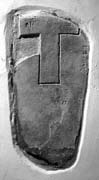
Object type: Cross-slab with inscription
Measurements: H. 65 cm (25.5 in); W. 35 cm (13.8 in); D. unknown
Stone type: Difficult to make accurate observations as there is virtually no fresh surface — pale red (5R 6/2), non-calcareous, clast-supported, micaceous, fine-grained sandstone. The sub-angular to sub-rounded quartz grains vary from 0.1 to 0.2 mm. St Maughan's Formation? (Lower Old Red Sandstone Group, Old Red Sandstone Super Group), early Devonian age.
Plate numbers in printed volume: Ills. 509-11
Corpus volume reference: Vol 10 p. 287-8
(There may be more views or larger images available for this item. Click on the thumbnail image to view.)
According to Allen (1902), this stone was 'dug up by some quarrymen about three years ago, just outside the churchyard'. Watkins (1927–9, 204) initially quoted a Mrs Richmond as telling him that this stone (and also Llanveynoe St Peter 2) had been found more than 40 years previously to the west of the church on the slope towards the Olchon Brook (with an alternative provenance, from an old 'Saxon burying ground' north of the church). Watkins subsequently discussed the discovery of Llanveynoe St Peter 1 with Mr G. R. Trafford (who had also been Romilly Allen's informant and who had been present at the time of the discovery); according to this account, the stone was found c. 1888 to the north of the churchyard (Watkins 1927–9, 206). Watkins later reported that he had gathered more information from a mason who had been engaged in (unspecified) restoration work at the church; the mason said that 'he dug up human remains in raising stone a score of yards or so to the west of the present churchyard, outside its limits'. Watkins concluded that both nos. 1 and 2 were likely to have come from the area to the west of the churchyard (Watkins 1930–2). The stone was set in its present position in 1912, and had been lying loose in the churchyard prior to the enlargement of the church in that year.
Inscribed cross-slab. The slab tapers slightly towards the bottom, where it is rounded and slightly damaged. The upper part of the slab is missing. The stem and arms of the straight-sided, deeply incised cross survive. There is no other decoration.
Inscription On the right arm of the cross is the letter Ω (omega), while on the left is XPC (the contraction for Christos). At the top of the shaft immediately below the cross-arms, the letters IHS are inscribed (the contraction for Iesos). Running down the right edge of the slab there are three lines of inscription which read:
HAERDUR {h} FECIT
CRUCEM
ISTAM
Haerdur made this cross
Inscription The half-uncial lettering is discussed by Gifford Charles-Edwards in Redknap and Lewis 2007, 534. She suggests that the sacred monograms look as if they may be by different hands at different times; that CRVCEM ISTAM appears less homogeneous than HAERDUR FECIT; and that the 'h' before FECIT is a later addition. Ken Jukes (pers. comm. after site visit) similarly suggested that CRVCEM may have been added, since it is not incised in the same manner as the rest of the inscription.
Patrick Sims-Williams, in Redknap and Lewis 2007, 534, analyses the personal name HAERDUR (Old Welsh Heardur, Modern Welsh Iarddur, Arddur) as probably a compound of haearn 'iron' and dur 'steel'. In the lack of a composition vowel between the two elements, it displays a linguistic feature that would not be expected much before the end of the sixth century (Sims-Williams 2003, 285), but there is nothing to indicate a later terminus.
The name Llanveynoe indicates that the church was originally dedicated to St Beuno, a saint normally associated with Gwynedd. The Middle Welsh Life of St Beuno, written in 1346 but probably based on an earlier Latin Life, claims that St Beuno established a monastery in Ewias at an early stage in his career, and it would seem likely that this refers to Llanveynoe (Wade-Evans 1930, 315–16, 326 n. 12). However, it seems improbable that the author of the first Life had access to any genuine traditions concerning the establishment of a monastery at Llanveynoe by St Beuno (who probably lived in the first half of the seventh century); more probably this is an inference on the part of the author of the first Life, based on the existence of a church in Ewias with this dedication. In the later medieval period, Llanveynoe was a chapelry of the nearby church of Clodock (see catalogue entry above), and Llanveynoe may always have been subordinate to this important centre.
