Select a site alphabetically from the choices shown in the box below. Alternatively, browse sculptural examples using the Forward/Back buttons.
Chapters for this volume, along with copies of original in-text images, are available here.


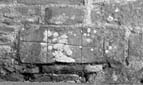
Object type: Cross-carved stone
Measurements: L. 62.5 cm (24.6 in); W. 21.2 cm (8.33 in); D. unknown
Stone type: Fine-grained sandstone, deep red in colour — probably the same as the other carved stones from the site (see Llanveynoe 1 and 2).
Plate numbers in printed volume: Ills. 517-8
Corpus volume reference: Vol 10 p. 290
(There may be more views or larger images available for this item. Click on the thumbnail image to view.)
Small slab probably originally wider at the top than the bottom (the original right side — at present the top edge — is damaged). The stone bears a simple cross (type A1), incised as single vertical and horizontal lines 0.4 cm deep. These incised lines are smooth and rounded in profile. The cross stands on a base line, 12 cm (4.72 in) wide, that is pecked rather than continuously incised, and there is a short crosslet line near the top of the upper arm that is also pecked.
Cross-slabs with simple incised or pecked linear crosses are notoriously difficult to date. Recent scholarship has tended to support Nash-Williams' proposed date of seventh to ninth century for many of these monuments, while acknowledging that some are more problematic (Edwards 2007, 63–72, fig. 7.2; Redknap and Lewis 2007, 136–7, 145–6). Cross-carved stones are widespread across south and south-central Wales, acting in the earlier periods as simple grave-markers, praying stations or boundary markers (Redknap and Lewis 2007, 137). Llanveynoe St Peter 4 has been broken off at the base, and this probably indicates that it was originally set in the ground. A stone bearing a sixth-century inscription was found not far from Llanveynoe church at Olchon House (see entry below, p. 291) and it is possible that nos. 4 and 5 might have been associated with it.
