Select a site alphabetically from the choices shown in the box below. Alternatively, browse sculptural examples using the Forward/Back buttons.
Chapters for this volume, along with copies of original in-text images, are available here.


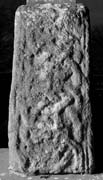
Object type: Cross-shaft
Measurements: H. 95 cm (37.3 in); W. 49 > 41 cm (19.3 > 16.1 in); D. 36 > 31 cm (14.2 > 12.2 in).
Stone type: Non-calcareous, pale yellowish brown (10YR 6/2), coarse-grained, poorly sorted, clast-supported, quartz sandstone. The sub-angular to sub-rounded clasts range from 0.3 to 5.0 mm; they mostly consist of clear quartz, but there are scattered fragments of white quartzite and white feldspar. Bromsgrove Sandstone Formation, Sherwood Sandstone Group, Triassic.
Plate numbers in printed volume: Ills. 592-6
Corpus volume reference: Vol 10 p. 339
(There may be more views or larger images available for this item. Click on the thumbnail image to view.)
The stone was incorporated in a memorial cross erected in the churchyard in 1871. It had been moved not long before into the churchyard from the stableyard of the adjacent rectory, where it was used as a horseblock (information from historical notes by Edwin Smith, together with a letter from Frances Seymour dated 31 March 1915, both in Warwickshire County Record Office DR 0736/1). The Record Office also holds the negatives of two photographs of the cross by E. W. Jephcott; they seem to date from the late nineteenth or early twentieth century. PH1035/B2829(N) shows the north and east faces, and PH1035/B2828(N) shows the south and east faces.
The shaft is rectangular in cross-section and each face is outlined with a double moulding. On the west face (face C) the surviving fragment of the outer moulding in the upper left is decorated with a cable pattern.
A (broad): This face carries long, curving diagonal strands of broad interlace laid out in a rather casual manner. Some at least of the interlace strands are median-incised.
B (narrow): Little of the design survives in the central portion of this face. There are loose, broad, median-incised loops of interlace in the lower half and a sharply-angled section of median-incised interlace in the upper right.
C (broad): As with face B, very little of the design survives. A sharp-angled return of median-incised interlace occurs in the top left corner. Across the top of this face there is a narrow, downward-curving moulding that probably defined the lower edge of a zone of carving on the now missing upper part of the shaft. Below the corner of interlace there is a raised area of stone with a flattened surface across which a broad, rounded moulding passes in a tight curve. The lower part of the raised area is slightly higher than the rest and has a curving upper edge from which the curving moulding rises. The lower two-thirds of this face of the shaft is so badly weathered that it is difficult to assess how much of the original carved surface has been lost, but the raised area may simply be a surviving part of the interlace or the remains of a larger component in the design — perhaps a figure.
D (narrow): The design survives over almost all of this face, and consists of fairly heavy interlace laid out in two columns with occasional diagonal linking strands. The double border curves slightly inwards towards the top of the stone.
Initially it was thought that the carving on face A resembled Borre-style ring-chain, but night photography has allowed more detail to be seen, and it is now clear that this is not a monument with Viking-inspired decoration but instead it is a more standard west Mercian cross. The interlace is broad and heavy, but it was probably all originally median-incised, with sharply-angled corners at the top of the shaft. There is little indication of a grid behind the interlace, although the double-column layout with linking strands on face D shows that the carver was capable of fairly complex design. Broad, rather simple interlace with angled corner-returns is found on several late tenth-/eleventh-century carvings from the area, for example the cross-head fragment from Whitchurch, Warwickshire (no. 1, Ills. 603–6), the small cross from Westbury, Shropshire (Ills. 560–1), and a grave-cover from Bibury, Gloucestershire (no. 3, Ill. 33). A similar date for the Kinwarton cross-shaft would seem likely, although the slightly greater degree of complexity on face D might indicate a date in the late tenth century rather than later.
