Select a site alphabetically from the choices shown in the box below. Alternatively, browse sculptural examples using the Forward/Back buttons.
Chapters for this volume, along with copies of original in-text images, are available here.


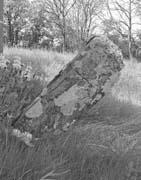
Object type: Slab with incised cross
Measurements: H. (visible) 61 cm (24 in); (in Redknap and Lewis 2007) 77 cm (30.3 in); W. 59 cm (23.2 in); D. 23 cm (9 in)
Stone type: Heavily encrusted with lichen and difficult to find a fresh surface. Pale red (10R 6/2), fine-grained, non-calcareous, clast-supported, slightly micaceous, flaggy sandstone bedded in units 3.0 to 20 mm thick. The sub-angular to sub-rounded quartz grains vary from 0.1 to 0.25 mm. St Maughan's Formation? (Lower Old Red Sandstone Group, Old Red Sandstone Super Group), early Devonian.
Plate numbers in printed volume: Ills. 534-5
Corpus volume reference: Vol 10 p. 296-7
(There may be more views or larger images available for this item. Click on the thumbnail image to view.)
Large, square-topped, cross-incised slab, tilted forward at a rakish angle. Deeply incised cross with expanding arms on east face of stone, one arm now badly worn. Incised horizontal line on narrow south face c. 30 cm down from top of stone. The remains of a rectangular socket (5.5 x 2.5 cm) survive in top of stone.
Appendix A item (stones dating from Saxo-Norman overlap period or of uncertain date)
This massive stone slab is also included in the Welsh Corpus South-East volume, where the authors note that 'Kenderchurch was formerly Lancinitr, suggesting a dedication to St Cynidr' (Redknap and Lewis 2007, 531, citing Wedell 1997, 84). They also suggest that the carving is probably eleventh/twelfth century in date (Redknap and Lewis 2007, 530–1).
The name lanncinitir is first found in a list in the Book of Llandaf of places (in Ergyng and elsewhere) at which Bishop Herewald (c. 1056–1104) is claimed to have exercised episcopal functions; according to this list he had consecrated the church and appointed first a priest called Aircol and then his son Enniaun (Evans and Rhys 1893, 275–8; Davies 2003, 26–9).
