Select a site alphabetically from the choices shown in the box below. Alternatively, browse sculptural examples using the Forward/Back buttons.
Chapters for this volume, along with copies of original in-text images, are available here.


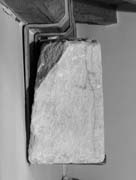
Object type: Panel in two joining pieces
Measurements: H. 38.5 cm (15.1 in); W. 74.5 cm (29.3 in); D. 23 cm (9 in)
Stone type: Very pale orange (10YR 8/2) shelly oolite, grain supported, in a muddy matrix. Many hollow ooliths which range in size from 0.2 to 0.8 mm. Shell debris up to 10 mm in size. Cleeve Cloud Member, Birdlip Limestone Formation, Inferior Oolite Group, Middle Jurassic.
Plate numbers in printed volume: Ills. 19-20
Corpus volume reference: Vol 10 p. 132
(There may be more views or larger images available for this item. Click on the thumbnail image to view.)
The two pieces comprising Berkeley (Castle) 3 would appear to be the stones described as displaying 'palmetto (twice moulded side by side, in relief), and some small braided eyelet-ornaments (? for inlay-work)' which St Clair Baddeley stated to have been discovered in July 1923 'high up in the outer (NE) wall of the chapel-turret to the keep' (Baddeley 1926, 140–1). In his subsequent rejoinder, the Earl of Berkeley commented that: 'This alludes to a fragment found in the east wall of the east tower of Thorpe's towers, — it was behind the present re-faced wall, and formed a lintel over a window. The stone lintel was not in its original position, its decorated face being concealed by other lintels' (Berkeley 1927, 184). Thorpe's Tower was built on the north side of the shell keep in 1342–6 (Verey and Brooks 2002, 176).
Panel with carved decoration that has been reused as a window lintel.
A (broad): There are four pointed oval recesses 2.5 cm (1 in) deep, surmounted by smaller circular recesses of similar depth. The top of the panel, above the carved decoration, curves outwards and there are some indications of carved folds in this area. The ovals and circles are surrounded by shallow, flat-faced borders. Between the recessed areas the face is carved with vertical, loosely twisted cable ornament within double, inward-curving borders. Above each of these panels of decoration there are plants that have palmate fans of broad leaves, and side shoots that curve downwards into tight spirals.
B and D (narrow) and C (broad): Plain
The main elements of this design all appear in the Pentecost scene from a late tenth-century manuscript illumination from Winchester, the Rouen Benedictional and Pontifical, fol. 21v. In this scene a roundel containing the Hand of God is set directly above an almond-shaped, pointed oval containing the Holy Spirit depicted as a Dove. Both roundel and oval are surrounded by contiguous borders. In the background there is an exuberant profusion of broad, fleshy leaves (Temple 1976, 53–4, cat. 24, colour frontispiece). The parallels are such that a late tenth-century date for the carving would seem reasonable, although West sees the leaf forms as more typical of the twelfth century (J. West, pers. comm. 2006). There is only room on the stone for half of the fourth oval and circle, indicating that the decoration continued onto at least one more, butt-jointed stone. If the second stone was of similar size, this would make the overall panel 1.5 m wide, with seven recessed oval and circle motifs representing, perhaps, the seven days of Creation. Such a scheme would be appropriate for the front of an altar or for a panel from a chancel screen. Alternatively this could be part of a shrine base with the recessed oval and circles forming false 'access' holes to the relics within (J. West, pers. comm. 2006).
