Select a site alphabetically from the choices shown in the box below. Alternatively, browse sculptural examples using the Forward/Back buttons.
Chapters for this volume, along with copies of original in-text images, are available here.


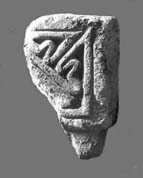
Object type: Impost
Measurements: H. 14.4 cm (5.7 in); W. (face B) 11.5 cm (4.5 in); D. (face A) 8 cm (3.2 in)
Stone type: Greyish orange (10YR 7/4) oolite with gains supported in a muddy matrix. A few of the ooliths are hollow, and they range in size from 0.2 to 0.8 mm. Very sparse shell debris. Cleeve Cloud Member, Birdlip Limestone Formation, Inferior Oolite Group, Middle Jurassic.
Plate numbers in printed volume: Ills. 21-4; Figs. 18B, 21B
Corpus volume reference: Vol 10 p. 132-3
(There may be more views or larger images available for this item. Click on the thumbnail image to view.)
Discovered during work on the keep at Berkeley Castle in September 1935 (Dobson 1936).
Carved impost, burnt after breaking. The background around the carving of faces A and B is cut back 1 cm. The profile of the impost is stepped progressively inwards through three stages, the lowest of which is little more than a fillet 0.5 cm deep.
A: Decorated with a diagonal key fret (see B below).
B: Divided into two panels and decorated with a linked diagonal key fret (Allen 1903, 327, no. 868).
This small fragment is the impost for an arch or doorway, and, together with the similarly decorated hood-moulding (Berkeley St Mary 2), indicates the presence of an early building on or near the site of the present parish church (which is adjacent to the castle). The key fret is delicate and deeply cut, offering a rich texture of light and shade. It is very similar to the fret on sections of the early ninth-century 'broad frieze' at Breedon-on-the-Hill in Leicestershire (Jewell 1986, 100–3, pls. XLVIIa, c), and also similar to a fragment from Glastonbury dated to the late eighth or early ninth century (Cramp 2006, 157–8, ill. 251). Indeed, the Berkeley and Glastonbury pieces are so similar that they could have been cut by the same hand. If so, this would provide an interesting counterpart to the evidence for patronage of Glastonbury by eighth- and ninth-century Mercian kings (summarised in Abrams 1996, 335–7). It is also possible that the Æthelmund who gave a minor benefaction to Glastonbury in association with King Offa is one and the same as the Hwiccian Æthelmund father of Æthelric; the family of Æthelmund and Æthelric evidently had close ties to Berkeley (Abrams 1996, 142–3; Sims-Williams 1990, 39 n. 117; Hare forthcoming b). Key fret was a popular decorative motif in the late eighth century. Carved ivory examples include the borders on one leaf of the Genoels-Elderen Diptych (Musées Royaux, Brussels: Beckwith 1972, 20–2, 118–19, ill. 14), while manuscripts which use key fret for borders decoration and the infill of initial letters include the late eighth-century Hereford Gospels (Alexander 1978, 63–4, cat. 38, ills. 197, 199; Webster and Backhouse 1991, 127–8, ill. 91; and this volume, Ills. 771–2), the Book of Kells (Alexander 1978, 71–6, cat. 52, ill. 231 (fol. 27v); Henry 1974, fols. 114v, 124r) and, perhaps slightly earlier, the Lichfield Gospels (Alexander 1978, 48–50, cat. 21, ills. 80, 82; Henderson 1987, 122–9, ills. 180, 185–6).
