Select a site alphabetically from the choices shown in the box below. Alternatively, browse sculptural examples using the Forward/Back buttons.
Chapters for this volume, along with copies of original in-text images, are available here.


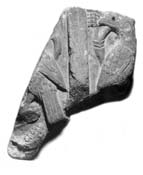
Object type: Part of panel
Measurements: H. 26.7 cm (10.5 in); W. 21.7 cm (8.5 in); D. max. 5 > 3 cm (1.9 > 1.2 in)
Stone type: Light olive grey (5Y 6/1) oolite with gains supported in a muddy matrix and showing very few hollow grains. The ooliths range in size from 0.2 to 0.5 mm. Cleeve Cloud Member, Birdlip Limestone Formation, Inferior Oolite Group, Middle Jurassic.
Plate numbers in printed volume: Ills. 17-8; Figs. 24F
Corpus volume reference: Vol 10 p. 131
(There may be more views or larger images available for this item. Click on the thumbnail image to view.)
Carved panel. The carving is very well executed, and up to 2 cm deep. The eye of the right-hand bird has been drilled. The surface of the stone is highly finished, but there is no obvious indication of pigment. However, the stone is encrusted with grime and this not only obscures the colour and details of the geological composition of the stone, but it may also obscure minute traces of gesso. The stone is set into the plaster on the wall so it is not possible to see the back.
A (broad): There are two opposed birds with heads turned back to face each other across a wide, median-incised central rib that divides the carved surface into two. This rib is flat in profile but rises towards the centre. The head of the surviving bird is pecking at a grape or berry bunch which springs from the node of a plant stem. The birds are beautifully carved with flight, wing and tail feathers carefully observed, and the surviving eye and beak of the right-hand bird meticulously detailed. Behind the birds the vine stems are half-round in cross-section, and the berry bunches are tight and sharply defined.
B and D (narrow): Broken away on all sides.
The two birds on this stone are carved in a fully naturalistic manner similar to the birds on the earliest of the Gloucester crosses (Gloucester St Oswald 1, faces A and B). The birds on St Oswald 1A are even addorsed in the same way on either side of a wide, flat, double central rib (Ills. 265, 268), while on 1B a smaller bird pecks on tight berry clusters which are again very similar to those on this Berkeley stone (Ill. 269). The eye of the right-hand bird is drilled, perhaps for the insertion of glass or a jewel. The lack of weathering presumably indicates that this stone was part of an internal rather than external structure. This, and the quality of the carving, suggests that it was part of a closure screen, or perhaps a side panel for an altar or tomb. The eucharistic significance of the prominent grape bunches makes the suggestion that this fragment came from a closure screen particularly apt. Such a carving would almost certainly have been painted but there is no obvious surviving pigment or gesso. A date in the late eighth century, similar to the St Oswald's stone, would seem probable.
