Select a site alphabetically from the choices shown in the box below. Alternatively, browse sculptural examples using the Forward/Back buttons.
Chapters for this volume, along with copies of original in-text images, are available here.


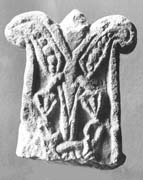
Object type: Top arm of cross-head or finial
Measurements: H. 22 cm (8.6 in); W. 18 > 13.6 cm (7.1 > 5.3 in); D. 9 > 8 cm (3.5 > 3.1 in)
Stone type: Very pale orange (10YR 8/2) grain supported shelly oolite with a sparry matrix. Ooliths are commonly hollow and range in size from 0.2 to 0.8 mm. The shell debris can be up to 5 mm. Bedding parallel to face of stone. Cleeve Cloud Member, Birdlip Limestone Formation, Inferior Oolite Group, Middle Jurassic.
Plate numbers in printed volume: Ills. 13-6; Figs. 27H, 34D
Corpus volume reference: Vol 10 p. 130-1
(There may be more views or larger images available for this item. Click on the thumbnail image to view.)
This would appear to be the stone described as a 'fragment of a late Saxon cross, having upon it a head of Christ nimbed in low relief' which St Clair Baddeley stated to have been discovered in July 1923 'high up in the outer (north-east) wall of the chapel-turret to the keep' (Baddeley 1926, 140–1). The Earl of Berkeley subsequently published a rejoinder, drawing attention to Baddeley's 'numerous errors'; he stated that this piece was in fact discovered 'under the floor of the priest's room adjacent to St Mary's chapel' (Berkeley 1927, 183–4). The chapel of St Mary was one of two chapels in the castle; it was converted into a morning room in 1923 (Verey and Brooks 2002, 179), so the date given by Baddeley may be correct.
This seems to be the top arm of a cross-head, or a decorated finial. Face A and the top of the stone carry traces of pink or red colour on their surfaces. This may be the result of burning or the last remains of pigment. Face C is much more weathered than face A.
A (broad): This face is well carved and the background to the carving is cut back 0.8 cm (0.3 in). A twin-stemmed plant rises through a simple collar flanked by out-turning, hollow-centred leaves. The plant stems then pass below a pair of downward-pointing leaves before terminating in two pods. The pods have split to reveal rows of well-rounded peas or seeds. The upward-pointing tips of the pods curl out to fill the 'horn' terminals.
B and D (narrow): Plain
C (broad): The carving here is much cruder than on face A and is cut much more deeply (up to 1.5 cm / 0.6 in deep). The face of the stone carries diagonal fine-point scoring, and bears traces of rough setting-out lines above a rectangular area that has been cut back into a shallow recess. Below the rectangular area, and carved even more deeply into the stone, is a simple oval head with a low forehead, long straight nose, bulbous eyes and a thin, straight mouth. A small part of the figure's right shoulder survives. The head is rounded and in low relief.
The remains of a shoulder (or arm pit) at the bottom of this stone indicates that it was part of a larger, wider carving. This could suggest that the stone was originally a finial from the roof of a building or tomb, or that it was the vertical arm of a cross-head with the shoulder being the remains of one of the horizontal arms. The carving on the stone would appear to more readily support the latter interpretation, because it seems to be of two phases: the plant and pods of face A are of much better quality than the head carved on face C. One interpretation might be that the stone was originally designed to be seen from one side only, perhaps set against a wall, and that it was later moved, possibly for reuse as a grave-marker, at which time the back became available for decorative use. In this case the carved head might be part of a crucifixion or part of a portrait figure. Strangely it has been the carved head, rather than the earlier 'pod and leaf' face that has been published previously (Baddeley 1926, 141; Dobson 1933, 271, fig. 13). The stone tapers upwards from the remains of the shoulder, before flaring out into two curving 'horns' either side of a central, diamond-shaped capping. This detail is unusual in stone carving, but very similar to the finials on the top borders or corners of many illuminations in early Anglo-Saxon manuscripts. Several of the carpet pages from the Lindisfarne Gospels show this detail (Backhouse 1981, 34, 42, 56), as does the King David page from the Durham Cathedral Commentary on the Psalms by Cassiodorus (Webster and Backhouse 1991, 125–6, ill. 89). Mid to late eighth-century examples from Mercia can be found on the decorated opening folios of the gospels of St Mark and St John in the Hereford Gospels (Alexander 1978, 63–4, cat. 38, ills. 198, 199; this volume, Ills. 771, 772), and on the carpet page and introduction to the gospel of St Luke in the Lichfield Gospels (Alexander 1978, 48–50, cat. 21, ill. 82; Webster and Backhouse 1991, 126–7, ills. 90, 91). The pod and leaf decoration is more difficult to parallel, but it is similar to a small early ninth-century trial piece from St Augustine's Abbey in Canterbury (Tweddle et al. 1995, 134–5, ills. 54, 55).
It is evident that there was an important minster at Berkeley with a complex history. The minster is best attested in the ninth century, when several documents (dated 804, 824 and 883) relate to a dispute between Berkeley's minster community and the bishops of Worcester (Sawyer 1968, nos. 1187, 1433, 218). An abbot Tilhere is possibly attested from 759 until the late 770s and an abbess Ceolburh is reported to have died in 807; however, the sources for the association of these individuals with Berkeley are late and problematic. More securely attested is an abbot (perhaps called Æthelhun) in 883, while an abbess Ælfthryth was commemorated in the Liber Vitae of the New Minster at Winchester and was perhaps active in the late tenth or early eleventh century (Taylor 1894–5; Wormald 1986, 152–7; Sims-Williams 1990, 137, 158–9, 172–6; Foot 2000, ii, 39–42; Hare forthcoming b). Domesday Book refers to the destruction of the abbey (Moore 1982, no. 1, 63), presumably the female community formerly headed by Ælfthryth (see also Chapter II).
