Select a site alphabetically from the choices shown in the box below. Alternatively, browse sculptural examples using the Forward/Back buttons.
Chapters for this volume, along with copies of original in-text images, are available here.


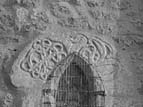
Object type: Reused grave-marker?
Measurements: H. 33 cm (13 in); W. c.64 cm (c.25.2 in); D. unknown
Stone type: Greyish orange (10YR 7/4), matrix-supported, shelly oolite. The ooliths, most of which have fallen out to give an 'aero-chocolate' texture, range from 0.3 to 0.6 mm, but are mostly between 0.4 and 0.5 mm; they form 50–60% of the rock There are common sub-rounded and platy shell fragments up to 5 mm across which form about 10% of the rock. Cleeve Cloud Member, Birdlip Formation, Inferior Oolite Group, Jurassic.
Plate numbers in printed volume: Ill. 617; Fig. 29B
Corpus volume reference: Vol 10 p. 346-7
(There may be more views or larger images available for this item. Click on the thumbnail image to view.)
Noted by Salzman (1949, 15). This stone is likely to have been in its present position since the thirteenth century.
Panel with a semi-circular top, carved with two, seemingly unrelated motifs in shallow relief. Both motifs are cut by the pointed head of a thirteenth-century window. On the left side there is a slightly distorted, closed-circuit knot with double strands that cross at the centre and loop around the double encircling strands. To the right there is a strange, apparently headless, serpentine creature with what appears to be a two-toed foot at the top left and a tail that sweeps up across the body before splitting in two to end in two tight, downward-curving tips. Above this are disjointed loops that curve around a crescent-shape. It is possible that what is described above as the split tail should be seen as the creature's head, seen from above. In which case the two curving tips might be intended to represent the creature's eyes and the disjointed loops might be its tongue, with the foot-like appendage then becoming a forked tail.
Appendix A item (stones dating from Saxo-Norman overlap period or of uncertain date)
Pevsner suggested that this stone was a remodelled Anglo-Danish window-head and therefore evidence for a eleventh-century church (Pevsner and Wedgwood 1966, 86). The Romanesque Corpus entry by H. Sunley supports an early eleventh-century date for this stone (Sunley 2008). However, as indicated above, the two motifs on the stone seem unrelated and may not be strictly contemporary, a suggestion reinforced by the fact that they run into each other just above the area cut away by the thirteenth-century window-head. Of the two carvings, the encircled knot is more carefully laid out on the stone, with the same margins above and below (as the stone is now set in the wall) and probably to the left as well. This in turn might support the suggestion that the stone was originally rectangular, as wide and as high as the present stone at its widest dimensions. Such a stone, blank at the bottom and carved at the top, would have been very similar to many late Anglo-Saxon grave-markers. A more geometrical version of the encircled knot pattern, used in square panels, can be found on Aycliffe 1, Chester-le-Street 1 and Durham 11, all in Co. Durham (Cramp 1984, pls. 7.26, 20.102, 49.235), and compare Lower Swell 1 in Gloucestershire (Ill. 477). It is, therefore, suggested that the encircled knot was carved in the early eleventh century (possibly as a grave-marker). The stone was reshaped as a tympanum or curved lintel in the later eleventh century with the serpentine creature perhaps added at the same time. Finally, in the thirteenth century, the stone was made into a window-head.
