Select a site alphabetically from the choices shown in the box below. Alternatively, browse sculptural examples using the Forward/Back buttons.
Chapters for this volume, along with copies of original in-text images, are available here.


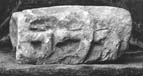
Object type: Cross-head fragment
Measurements: H. 12 cm (4.7 in); W. 26.5 cm (10.4 in); D. 15.5 > 12 cm (6.1 > 4.7 in)
Stone type: Moderately reddish grey to moderately orange pink (10R 5/6 to 10R 7/4) fine-grained to very fine-grained well sorted sandstone. Mainly quartz but with some mica and feldspar. Sub angular to angular grains 0.075 to 0.125 mm in size. Signs of bedding lamination parallel to main carving. Bromsgrove Sandstone Formation, Sherwood Sandstone Group, middle Triassic.
Plate numbers in printed volume: Ills. 618-20
Corpus volume reference: Vol 10 p. 353
(There may be more views or larger images available for this item. Click on the thumbnail image to view.)
This is part of a cross-head, with an encircled design on face A, a panel of interlace bounded by heavy, round edge-mouldings on face B, and part of what may be an arch on face C. The horizontal 'arms' and the fragment of 'stem' on face A carry wide, median-incised grooves. Having passed under the circle around the cross-head, the right arm swells quite noticeably.
It is difficult to say much about this small, heavily-weathered fragment, but the encircled design on face A would support a tenth-/eleventh-century date for the piece. The interlace on face B is deeply cut but rather crude. On face C the shape below the curving moulding might be the top of the head of a figure standing below an arch.
A church and a priest are recorded at Belbroughton in the Domesday survey; before the Conquest Belbroughton was held by Godgifu, the widow of Earl Leofric (Thorn and Thorn 1982, no. 26,13). Hemming maintained that Belbroughton had been unjustly seized from the cathedral community by Leofric and his family (Hearne 1723, i, 261–2). Tinti (2010, 266–7) suggests that the church may have originated in the eleventh century.
