Select a site alphabetically from the choices shown in the box below. Alternatively, browse sculptural examples using the Forward/Back buttons.
Chapters for this volume, along with copies of original in-text images, are available here.


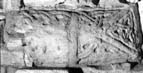
Object type: Coped grave-cover in two joining pieces
Measurements: L: 52 cm (20.4 in); W. 23.5 cm at widest (but broken along one edge) > 22.5 cm (9.2 > 8.8 in); D. unknown, but the highest point of the coping is 5 cm (1.97 in) above the lower border
Stone type: Yellowish grey (5Y 8/1) grain supported shelly oolite with a sparry cememt. The ooliths range in size between 0.2 and 0.6 mm and the shell debris (mainly bivalve material) between 4 and 5 mm. Cleeve Cloud Member, Birdlip Limestone Formation, Inferior Oolite Group, Middle Jurassic.
Plate numbers in printed volume: Ill. 5; Fig. 38
Corpus volume reference: Vol 10 p. 128
(There may be more views or larger images available for this item. Click on the thumbnail image to view.)
See Avening 1. St Clair Baddeley ((—) 1933, 7–8) refers to this fragment and perhaps implies that it was discovered in 1902–3.
Small coped grave-cover, broken into two pieces. Left end damaged and worn smooth. The surface of the stone is divided into panels and decorated with median-incised interlace. The triangular end-panel contains an interlace triquetra.
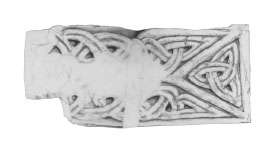
Fig 38
Small coped grave cover (Avening 2) (scale 1:10)
This small grave-cover may once have covered a child's grave. The coped form is unique in Gloucestershire, but is similar to a richly decorated coped gravestone from Durham (Cramp 1984, 73, pls. 49, 50), the round-ended coped gravestone from Ramsbury, Wiltshire (Cramp 2001, 158–9, fig. 2b) and to the flat-topped coped stone from Bexhill in Kent (Tweddle et al. 1995, 122–3, ills. 10–19). The rarity of the form locally is an indication that the stone marked an important grave, but the wear pattern suggests that the stone had been reused in a position where it was regularly walked over before being set in its present position.
