Select a site alphabetically from the choices shown in the box below. Alternatively, browse sculptural examples using the Forward/Back buttons.
Chapters for this volume, along with copies of original in-text images, are available here.


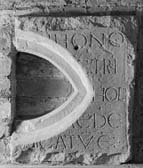
Object type: Inscription panel
Measurements: H. 58 cm (22.8 in); W. 48.5 > 47.5 cm (19 > 18.7 in) (lower edge trimmed obliquely); D. 15 cm (5.9 in) visible
Stone type: Yellowish grey (5Y 8/1) grain supported muddy oolite. Ooliths are mainly hollow and range from 0.2 mm to 1 mm in size. Cleeve Cloud Member, Birdlip Limestone Formation, Inferior Oolite Group, Middle Jurassic.
Plate numbers in printed volume: Ills. 232-3
Corpus volume reference: Vol 10 p. 195-7
(There may be more views or larger images available for this item. Click on the thumbnail image to view.)
Odda's Chapel formed part of the adjacent house called Abbot's Court and was itself unrecognised until restoration work began on the property in August 1885. As part of the works, some fruit trees to the south of the Chapel were cut down; the removal of one tree brought to light an inscription built into the chimney stack of the house just to the south of the chancel. A drawing of the inscription before its removal from the chimney stack was made by J. H. Middleton (London, Society of Antiquaries, MS 709/9 (10)). By 1887 the inscription had been removed to the interior of the Chapel; its former position in the chimney stack is marked by an area of patched masonry which corresponds in size to the inscription (Butterworth 1885; Middleton 1885–7; Butterworth 1886–7; Butterworth 1887, 93–107; Middleton 1887). The discovery of the inscription, in conjunction with the earlier discovery of the inscription Deerhurst Odda's Chapel 1, led to the realisation that both inscriptions refer to Odda's Chapel and not to the nearby Anglo-Saxon church of St Mary (Butterworth, 1885, 414–16; Okasha 1971, 63–5, pl. 29).
Good. Three edges of the original panel remain, showing a slightly raised border that is now almost completely cut away. The border area on the fourth side has been trimmed flush with the side of the inscription panel, but little of the carved face seems to have been lost.
Inscription[1] The other Anglo-Saxon inscription at Deerhurst was twice reused as a building stone, firstly as the head of a Gothic window and later in a post-Reformation chimney stack in Abbot's Court (the house built around Odda's Chapel). Nevertheless, although it is now incomplete, it remains less weathered than the dedication inscription (Deerhurst Odda's Chapel 1). This inscription panel differed from that of the dedication in being set within a raised border, now cut back but still traceable on three sides. As on the dedication inscription, the lettering is neatly laid out and executed. On this stone, however, finely incised horizontal guide-lines are still clearly visible at the tops and bottoms of the lines of lettering on the lower half of the stone. In the last line a separate guide-line seems to have been ruled for the abbreviation bars. The letter height of each line varies only slightly within the range between 5.1 and 5.8 cm. Spaces between lines are a little less consistent (4.5, 5, 5 and 3 cm). A slight miscalculation is suggested by the fact that the bottoms of the letters in line 3 ignore one guide-line and follow another 0.9 cm above. The text of the inscription should probably be reconstructed as follows:
[+ IN]HONO[RE S(AN)C(T)]E : TRIN[ITATIS] HOC [ALTAR]E DE[D]ICATV(M) : E(ST) :
+ This altar was dedicated in honour of the Holy Trinity.
The capitals are very similar in character to those on the dedication inscription (Deerhurst Odda's Chapel 1). They are broad letters, particular in the first line with its circular Os and square H and N. C in line 5, D, H, I, N, O, T and V correspond to their classical Roman forms. The A differs very slightly from the classical form in that the two diagonals do not quite meet at the top but are joined by a very short horizontal line. This was probably a slight miscalculation rather than a deliberately different form. As on the dedication stone, the bowl of the R is left open. Clear departures from Roman forms, both also found in the dedication inscription, are the square C in line 3 and the four remaining Es which are all round (uncial). There are no examples of inserted letters of ligatures in this inscription, but it should be noted, firstly, that the inscription is incomplete and, secondly, that such devices may have been thought inappropriate for this short and generously laid out text.
Some delicate modelling of strokes can be seen, for example on the final E, and strokes terminate in lightly splayed serifs. Two points are used to divide the last two words in line 5 and may also have been used in line 2. The inscription ends with a group of three points.
Dedications to the Holy Trinity were rare in England before the late twelfth century (Arnold-Foster 1899, i, 18, 25, iii, 368–73). The earliest dedication to the Trinity seems to have been at Aniane in southern France in the Carolingian period (Bishop 1918, 212, 500). See Raw 1997 for evidence of developing devotion to the Trinity in tenth- and eleventh-century England, and a handful of dedications to the Trinity of the same period, including that at Deerhurst (ibid., 10, 12–13).
The similarities in lettering between the two inscriptions are such that they were almost certainly designed and executed at the same time. Most of the apparent differences can probably be accounted for either as the result of differences in the condition of the surface of the two stones, or in how generously the texts are spaced.
(See also the discussion for the Deerhurst Odda's Chapel 1 inscription.)
