Select a site alphabetically from the choices shown in the box below. Alternatively, browse sculptural examples using the Forward/Back buttons.
Chapters for this volume, along with copies of original in-text images, are available here.


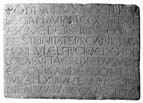
Object type: Inscription panel
Measurements: H. 69.5 cm (27.3 in); W. (top) 99 cm (38.9 in); (bottom) 99.5 cm (39.1 in); D. (top) 15.2 cm (6 in) broadening to 20 cm (7.9 in); (bottom) 16.8 cm (6.6 in) broadening to 25.7 cm (10.1 in)
Stone type: Very pale orange (10YR 7/4), sparry matrix supported oolite. Ooliths mainly hollow and 0.5 to 1.0 mm in size. Some shell debris mainly 3–5 mm but some up to 10 mm. Shell debris mainly bivalve. One Pentacrinus ossicle. Heavily patinated on inscription face with only small patches on the edge where the geology could be seen. May be more exposure on underside but too heavy to lift. Cleeve Cloud Member, Birdlip Limestone Formation, Inferior Oolite Group, Middle Jurassic.
Plate numbers in printed volume: Ills. 226-31
Corpus volume reference: Vol 10 p. 190-5
(There may be more views or larger images available for this item. Click on the thumbnail image to view.)
It is evident that the main Odda's Chapel inscription was known in the late Middle Ages, as garbled versions of it are found in late medieval Tewkesbury sources. These sources indicate that the inscription was to be found in the wall above the door of a small chapel which was opposite (contra) the gate of Deerhurst Priory (Higgitt 2004, 3, 35 n. 12); the location of the gatehouse of Deerhurst Priory is unknown, but may well have been towards the southern end of the present churchyard, in which case it would have stood opposite Odda's Chapel. When the Tewkesbury sources were first compiled, the inscription was presumably still in situ, but it must at some stage have been removed, perhaps when the chapel ceased to be used for worship and was converted to alternative use. The inscription was rediscovered c. 1675. According to Prideaux (1676, 309–10), the stone had recently been dug up at Abbot's Court, which was then leased by John Powell from the Dean and Chapter of Westminster; the stone was subsequently transferred to Powell's town house in Gloucester (where it was for a while on display) before being given to the Ashmolean Museum. Gibson's 1695 edition of Camden's Britannia gives the year 1675 as the date of discovery and adds that the stone was discovered in Mr Powell's orchard (Camden 1695, 245). If the discovery took place in 1675, there is a fairly tight timescale for the transfer to Gloucester, the display at Powell's town house and the subsequent move to the Ashmolean followed by Prideaux's publication in 1676. The information that the discovery took place in an orchard seems likely to be reliable; the field to the south of Odda's Chapel appears as an orchard on the enclosure map of Deerhurst dated 1815 (Gloucestershire Archives, P112a SD 1 & 3). Initially the inscription was thought to refer to St Mary's. However, in 1885 a previously unknown Anglo-Saxon chapel was found to have been incorporated in the sixteenth-century building of Abbot's Court, and the discovery of a second inscription nearby (Deerhurst Odda's Chapel 2) led to the realisation that both inscriptions refer to the building now known as Odda's Chapel and not to St Mary's (Haith 1984; Okasha 1971, 63–5, pl. 28).
The panel is rectangular and borderless. The inscribed face (A) has been rubbed or burnished smooth. The depth of the panel becomes substantially greater from left to right (as viewed from the inscription face — see dimensions above). This is largely because there is an area of raised stone at the right-hand end of the roughly finished back of the panel (C). The raised area covers the whole of the end of the stone and curves more than half way along the lower edge. At the left-hand end there are traces of what might be earlier carving in the form of folds or diverging lines and a faint double border. The raised area at the right-hand end might also be the remains of previous carving. The side faces (B and D) have been finished with diagonal, broad bladed tooling with some finer finishing, while the top and bottom faces (E and F) were finished with finer tooling running from front to back across the faces. The leading edges of all four narrow faces carry a 2–3 cm (0.8–1.2 in) strip that has been rubbed or burnished smooth, possibly indicting that the panel projected slightly from the surface of the wall in which it was originally set. There are rectangular slots cut into each of the narrow faces that were for securing the stone in its previous display location in the museum. In the centre of the upper face (E) there is a small drilled hole 1 cm (0.4 in) wide and 3 cm (1.2 in) deep. A similar sized hole has been drilled obliquely downwards into the upper left hand end (face D), and some stone has broken away around this hole. The purpose of these two holes is unclear.
Inscription[1] The lettering of the inscription commemorating the dedication of 1056 (see discussion below) is quite well preserved. A few letters have suffered minor damage and weathering has blurred some of the finer detail. The lettering has been neatly laid out in regular and carefully ruled lines, although the ruling is no longer visible. The letters are about 5 cm high (ranging from 4.6 to 5.9 cm). The space between lines ranges from 1.5 to 2 cm. The text may be edited as follows (Higgitt 2004, 21; see also Okasha 1971, 64):
+ ODDA DVX IVSSIT HANC
REGIAM AVLAM CONSTRVI
ATQVE DEDICARI IN HONO
RE S(ANCTE) TRINITATIS PRO ANIMA GER
MANI SVI ÆLFRICI QVE DE HOC
LOCO ASV(M)PTA E(ST) ALDREDVS VERO
EP(ISCOPV)S QVI EANDE(M) DEDICAVIT II IDI
BVS AP(RI)L(IBVS) XIIII AVTE(M) ANNO $ REG
NI EADWARD REGIS ANGLORV(M)
+ Earl Odda ordered this royal hall (i.e. church) to be built and dedicated in honour of the Holy Trinity for the soul of his brother Ælfric which was taken up from this place. And Bishop Aldred [or And Aldred [is/was] the bishop] who dedicated it on the second day before the Ides of April (12th April) in the 14th year of the reign of Eadward King of the English.
$ in line 8 indicates a redundant S that seems to have been due to an error in transcription. A lightly incised line leaning some degrees to the right away from the vertical runs through the letter and may perhaps have been intended to cancel it. [An alternative interpretation, made recently by David Howlett, is that the S is an abbreviation for SCILICET (Howlett 2005, 118–20).]
The Latin text ... starts with an abbreviated invocation of God, here by means of an incised cross. The text consists of two sentences with finite verbs, in the second case apparently omitted but understood, and each sentence ends with a relative clause. It opens with the name of the patron of the building followed by the verb of ordering, Odda Dux iussit (Earl Odda ordered). Then follow details of the command: firstly, that a regia aula, literally a royal hall or palace but here a church or chapel, should be built; secondly, that it should be dedicated in honour of the Holy Trinity (dedicari in honore Sanctae Trinitatis). The next section (pro anima germani sui Ælfrici qui de hoc loco as[s]umpta e(st)) is a statement of Odda's reason for having the church built, that is so that it might benefit the soul of his brother Ælfric, which had been taken up from this place (Deerhurst). The name Aldredus (or perhaps Ealdredus: see Okasha 1971, 64; Higgitt 2004, 43 n. 74) is the subject of a new sentence naming the presiding bishop and giving the date of the dedication. Aldredus vero episcopus qui eandem dedicavit can be translated as: 'And Bishop Aldred [Ealdred] who dedicated it' or 'And Aldred [Ealdred] [is/was] the bishop who dedicated it'. The dating formula gives the day of the month (the day before the Ides of April, that is 12 April) and the regnal year, which was the fourteenth of Edward the Confessor (XIIII autem anno regni Eadwardi regis Anglorum). As Edward was crowned on 3 April 1043, 12 April of the fourteenth year of Edward's reign would have fallen in 1056 (Fryde et al. 1986, 29).
The inscription is in capitals, which are mostly in their classical Roman forms. The regularity of the lettering and the breadth of many of the letters (for example the circular Os and Qs and the square proportions of letters such as M N and X) add to the classical impression. The principal departures from standard Roman forms are: rectangular C, which is used once as an alternative to the round form used in all other cases; uncial, or round, E, which is used more frequently than the standard square form (fourteen and four examples respectively); uncial, or round, H, used once as an alternative to standard square H (twice); and one example of a narrow O in the restricted space at the end of line 6. The base of the central 'V' in the letter M is set less than half the way down the letter, rather than descending to the bottom of the letter as in classical Roman capitals. The bowl of the Rs, as sometimes in antique inscriptions, is left open. The non-classical letter W is used in the English vernacular name EADWARD and takes the form of two overlapping Vs. This sound in Old English names was represented in various ways in inscriptions in roman lettering: the letter wynn, which was borrowed from the runic alphabet; V; VV; and two forms of W (one consisting of a ligature of two Vs and the other of overlapping Vs). The overlapping-V form of W only became common in England after the Norman Conquest, appearing for example in the Domesday Book of 1086, in the Great Seal of William II and in the Bayeux Tapestry (Hector 1966, pl. Ic; Kingsford 1929, 162, 174, 175; Wilson 1985). It has been said that the ligatured-V form of W was introduced into England by Norman scribes but it is worth noting that the overlapping-V form of W (as at Deerhurst) already appears in inscriptions in Germany as early as c. 1009 (on the bronze doors of Archbishop Willigis in Mainz (Gray 1986, fig. 94; Koch 1999, pl. 210)).
A striking characteristic of the Deerhurst dedication inscription is the use of devices originally intended to save space. There are ten examples of smaller letters being placed inside full-sized letters (inserted letters) or within the same space as the larger letter. (In each case the larger letter is a consonant and the smaller the following vowel.) There is also one ligature (of T and E). The overlapping Vs in the W of EADWARD can perhaps be seen as part of the same phenomenon. The Deerhurst inscription seems to reflect the decorative use of these devices (inserted letters, smaller letters, overlapping letters and ligatures) in several carefully designed Continental inscriptions of the eleventh century. These include the lettering on the bronze doors in Mainz (c. 1009), and in dedication inscriptions at Waha (1050) and Moissac (1063) and tomb inscriptions at Vienne (c.1032), Mainz and Marseilles (both c. 1048) (Deschamps 1929, 21–35, figs. 18, 19, 22, 23; Gray 1986, figs. 94, 98, 102; Koch 1999, pls. 210, 213, 215, 223).
There is one other feature of the lettering at Deerhurst that may derive, probably indirectly, from antique Roman inscriptions. The top of the L of AP(RI)L(IBVS) rises above the line and is crossed by a bar marking the abbreviation. The effect is reminiscent of the tall I and tall T seen in many antique inscriptions and imitated (with T only) on the inscribed slab with verse epitaph commissioned by Charlemagne to commemorate Pope Hadrian I following his death in 795 (Sandys 1927, 50, 52; Gray 1986, figs. 94, 98, 102; Scholz 1995, 120).
The Deerhurst capitals were carved quite shallowly and with no noticeable attempt at modelling, that is varying the breadth of strokes. There is now almost no trace of serifing, although hints of serifs on the F and first C of line 5 suggest that very light serifs elsewhere may have fallen victim to weathering.
Word division is inconsistent. Slight gaps were left between words more often than not. There are no certain indications of the use of points to make word division, although very shallow points could have weathered away.
The inscription is discussed below by the late John Higgitt, but, for the first time, it has been possible to study and photograph the back face (C) of this panel, and to offer the suggestion that the panel might be a reused earlier carving. If the panel is turned through 90 degrees with the right hand end at the bottom, the raised area of stone is seen to be fairly carefully shaped — rising diagonally from the corner before curving up along one side of the panel. Near the lower corner there is a rounded 'bump' that projects upwards from the diagonal edge. Of those who were there when this face of the stone was recorded, one suggested that the raised area looked rather like the open mouth of a great beast (rather similar to the Mouth of Hell), while the other thought that it looked more like a seated figure with a partially raised hand. It should be added that both also acknowledged that the raised area might simply be the result of uneven preparation of the stone and that our imaginations were getting the better of us. However, in the upper corner of the stone there is another area that also seems to retain traces of carving. As note in the description above, these traces look like folds or perhaps radiating rays, and there are very faint incised parallel lines that form a border along the top of the panel. It is suggested, therefore, that this stone is probably a reused (Roman?) carved panel.
Inscription The lettering of the Deerhurst dedication inscription, which is neat, well designed and carefully cut, is also unusually sophisticated in the context of surviving late Anglo-Saxon inscriptions on stone. The letters are remarkably classical-looking capitals, mostly in their 'Roman' forms but including the rounded, or uncial E and H, and square C. The letter-designer also made elegant use of space-saving devices such as the insertion of smaller letters into larger ones and ligaturing. This kind of lettering derives ultimately from the revival of Roman capitals in the Carolingian period but the more immediate sources are not so clear. It has something in common with the display scripts of some English manuscripts of the period of the tenth-century Benedictine Reform, such as the Benedictional of St Æthelwold, but it is likely that the use of smaller letters, inserted letters and a ligature reflects an awareness of eleventh-century fashions in Continental inscriptions ... Michael Hare (pers. comm.) suggests that Bishop Ealdred, who officiated at the dedication, might provide a plausible channel of influence. Ealdred, who was bishop of Worcester and later (1061–69) archbishop of York, was, among other things, a royal diplomat and a building patron (King 1996). Shortly before the dedication at Deerhurst he had spent a year in Germany on a diplomatic mission. Michael Lapidge has shown that Ealdred probably brought back an important liturgical text, the Romano-German Pontifical, while Michael Hare has shown good reasons for thinking that Ealdred's influence on English royal ceremonial drew on what he had seen in the German Empire (Lapidge 1983; Hare 1997, 50–2, 59–60).[2] Inscriptions associated with Ealdred's host, Herimann, archbishop of Cologne, or his immediate family, for example the inscriptions connected with the dedication in 1051 of the crypt altars in the church of the convent in Essen, of which Herimann's sister Theophanu was abbess, seem to have had no particular kinship with the Deerhurst lettering (Higgitt 2004, 36 n. 24). There was, however, a flourishing tradition of revived Roman capitals in eleventh-century German inscriptions and some, such as those on the bronze doors at Mainz (see above), anticipate the stylish space-saving devices that we see at Deerhurst. [A strikingly close parallel to the lettering of the Deerhurst inscription is provided by the dedication inscription dated 1058 from the chapel of St Nicholas at the cathedral of Worms; this has been characterised as the finest inscription of mid eleventh-century date found in the Middle Rhine (Fuchs 1991, 12–13, pl. 3). This small inscription is well designed and carefully cut in capitals mainly of classical form, but (as at Deerhurst) with examples of uncial as well as square E and H; the letter W is in the overlapping V-form. There is also one example of a smaller letter (a vowel) inserted in a larger one (a consonant). The cutters of the Deerhurst and Worms inscriptions operated in very similar traditions, and their training may perhaps have taken place at the same centre.][3]
The exploitation of devices such as inserted letters was not, however, limited to the Empire and eleventh-century examples can also be found in what is now France (Deschamps 1929, 21–35, figs. 18, 19, 22, 23). Even if it is difficult to identify the origin of the Deerhurst lettering, it is nevertheless very probable that Ealdred would have been able to put Odda into contact with people with the expertise to draw up, design and execute a stylish inscription in Latin that is correct (apart from what appear to be two or three errors of transcription) (Higgitt 2004, 37, n. 26). Nevertheless, although the form and language of the Deerhurst inscription are clerical and sophisticated, the point of view that it presents is that of the secular patron of the church, Odda.
Only two or three other late Anglo Saxon inscriptions on stone approach the Deerhurst inscription in the use of neat capitals and predominantly Roman forms. Of these, the closest are the broad capitals on the sundial at Great Edstone, Yorkshire (Higgitt in Lang 1991, 133–5, ills. 451–3). Roman capitals were also used for the display script in tenth- and eleventh-century English manuscripts and in some cases, such as the Benedictional of St Æthelwold, the forms and treatment are strikingly classical (Temple 1976, 49–53, no. 23). In many manuscripts and in most surviving inscriptions of the later Anglo Saxon period the capitals are freer and make use of angular and other non-classical forms. The background to the more classical treatment of Roman capitals at Deerhurst and in some manuscripts is to be sought in the revival of antique Roman capitals found in some Carolingian inscriptions and manuscripts rather than in the Roman originals. The principal inspiration for these capitals was no doubt the display script of Continental manuscripts of the ninth and tenth centuries and these became known particularly through the Continental contacts established at the time of the tenth-century monastic reform movement in southern England. There are, however, as has been suggested above, reasons for thinking that the designer of the Deerhurst capitals was aware of more recent developments to be seen in some Continental inscriptions which took a more decorative approach to the treatment of the revived Roman capitals of the Carolingian tradition (Neumüller-Klauser 1989; Scholz 1995).
The inscription does not relate to St Mary's, now the parish church and formerly that of the minster and monastery, but rather to the small Anglo-Saxon church that is now known as 'Odda's Chapel', as was recognized in 1885 when the latter was discovered, a couple of hundred yards to the south of St Mary's, embedded in a house known as the Abbot's Court (see above). This identification was confirmed by a second inscription that was found reused in the chimney-stack of the Abbot's Court, having previously been re-cut to serve as a window head (Deerhurst Odda's Chapel 2, Ills. 232–3). The second inscription is now incomplete but can be reconstructed with confidence as having recorded the dedication of an altar to the Holy Trinity, the same unusual dedication as in the longer inscription. A late medieval chronicle of Tewkesbury Abbey gives an account of the principal inscription (no. 1) that is somewhat garbled but clearly based on an eye-witness account (BL Cotton MS Cleopatra C.III, fol. 210v; Dugdale 1846, ii, 59–60; see Higgitt 2004, 35, n. 12). It seems to echo the wording of the inscription in referring to the chapel as an aula regia and it states that the inscription could be then seen in the wall over the door of a small chapel opposite the priory gate at Deerhurst, although it does not specify whether it was on the inner or the outer face of the wall, or whether the door in question was the north door or the south.
We should try to establish the nature of the building that was being dedicated. The inscription calls it a regia aula, literally a royal hall or palace. Aula is frequently used in inscriptions and elsewhere as a word for a church but the significance of the adjective regia, or royal, is not so clear (Higgitt 2004, 35, n. 13) ... It is tempting to look for royal connections in eleventh-century Deerhurst, since Earl Odda was a kinsman of King Edward and, following his death on 31 August 1056, only a few months after the dedication, his lands at Deerhurst passed to the king (Williams 1997a, 3). It is, however, very unlikely that a complex of secular buildings would be dedicated to the Holy Trinity. It is clear that regia aula was used here as a synonym for basilica (from the Greek for king, prince or ruler), a word often used for a church building because, as the dedication service in the tenth-century Romano-German Pontifical points out, it means royal palace (in the Latin regia) and it was used in order to show that a church was the dwelling place of the eternal king (habitaculum regis eterni) (Vogel 1963, 92; Parsons 2000, 225–8). The reference then was to divine kingship and not to the king of England.
The primary, ecclesiastical function of a dedication inscription such as that from Deerhurst is to form a permanent and public record that the church has been consecrated and of essential details, in particular the name in which it was dedicated, usually that of a saint but here of the Holy Trinity, and of the day and months for annual celebration (Higgitt 1979; id. 2004, 35 n. 11). Most of the information in this inscription is therefore not strictly necessary from an ecclesiastical point of view. The inscription was plainly designed to emphasize the role of Earl Odda (see Higgitt 2004, 7–15, 34 n. 5). The text opens with the generously spaced words, ODDA DVX, and it makes clear that it was by Odda's initiative that the church was built and dedicated. The inscription records that he intended the church to served as a form of chantry for the benefit of the soul of his brother Ælfric, who had died at Deerhurst in 1053. This intention and Odda's special concern with family in the church that he built on his estate is neatly, and surely deliberately, highlighted by placing Ælfric's name in the middle of the middle line (line 5). The middle letter of his name, R, lies at the centre point of this face of the stone. The inscription closes with the regnal year, which also has the effect of commemorating secular authority in both the first and last lines, that of the earl and that of his kinsman, King Edward. Some care has also apparently been taken to place the details of the dedication symmetrically in the two lines above and the two lines below the middle line that is focused on Ælfric. Forms of the verb dedicare (to dedicate) appear two lines above and two lines below his name and the names of the dedicatee, the Holy Trinity, and of the officiating bishop, Ealdred, are placed immediately above and below. The emphasis on the aristocratic patron and his brother is unmistakable but the means by which it was achieved were quite subtle. The use of the exact middle of an inscription to honour or emphasize a name or word and the symmetrical mirroring of words about the middle line of an inscription seem both to have been very unusual, but a handful of prestigious examples in Rome or with Roman connections suggest that the designer of the Deerhust inscription may have been aware of a rare tradition in the layout inscriptions that had the added attraction of Roman origins (Higgitt 2004, 29–33, appendix 3).
The similarities in lettering between this inscription and Deerhurst Odda's Chapel 2 are such that they were almost certainly designed and executed at the same time. Most of the apparent differences can probably be accounted for either as the result of differences in the condition of the surface of the two stones, or in how generously the texts are spaced.
Odda first appears as a witness in a document of 1013. In 1051–2 Odda was briefly earl of the western shires of Wessex during Godwine's exile, and on Godwine's return, he was compensated with an earldom in the south-west Midlands. He died at Deerhurst on 31 August 1056 soon after the dedication of the chapel. For his career see Williams (1997a) and Bolton (2010).
[1] The description and discussion of the inscription have been adapted by R.M.B. from the late John Higgitt's Deerhust Lecture (Higgitt 2004), in which fuller references will be found.
[2] Currie (2010, 18) has reently elaborated the Ealdred connection further, suggesting that Ealdred was responsible for the reappearance of the lapidary inscription in England in the 1050s under the influence of continental models. [M.H.]
[3] The material on the inscription from Worms has been contributed by M.H.
