Select a site alphabetically from the choices shown in the box below. Alternatively, browse sculptural examples using the Forward/Back buttons.
Chapters for this volume, along with copies of original in-text images, are available here.


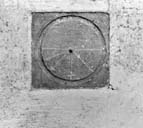
Object type: Sundial
Measurements: H. 32 cm (12.6 in); W. 31 cm (12.2 in); D. unknown
Stone type: Greyish orange (5YR 7/2) grain supported shelly, muddy oolite with many hollow ooliths which range in size between 0.2 and 0.6 mm. The shell debris is 2 to 3 mm in size. Cleeve Cloud Member, Birdlip Limestone Formation, Inferior Oolite Group, Middle Jurassic.
Plate numbers in printed volume: Ill. 491
Corpus volume reference: Vol 10 p. 273-4
(There may be more views or larger images available for this item. Click on the thumbnail image to view.)
The sundial is circular and is set above the south doorway. The dial is carved onto a square stone on which the dial itself is outlined by a raised roll-moulding with an external diameter of 29.5 cm (11.6 in). The gnomon hole is still visible. The face is divided in two by a horizontal incised line, and the lower half-circle contains four incised radii. Three of the radii are crossed at the outer end, and divide the dial into four quadrants. The fourth radius is not crossed. All the markings are very well preserved, presumably because the dial has long been protected by the south porch.
Appendix D item (sundials presumed to be of pre-Conquest date).
This circular dial is probably contemporary with the late Anglo-Saxon nave. Green gives an account of the Anglo-Saxon division of the day into four, 3-hour tides, whose mid-points are marked by the lines on the dial (Green 1928, 503, fig. 14). Taylor and Taylor quote Green, and add that the extra, shorter line in the first space on the Daglingworth dial marks the beginning of the morning 'tide' at 7.30 am; this line was known as daeg mael, day's marker (Taylor and Taylor 1965, i, 188 n.1).
