Select a site alphabetically from the choices shown in the box below. Alternatively, browse sculptural examples using the Forward/Back buttons.
Chapters for this volume, along with copies of original in-text images, are available here.


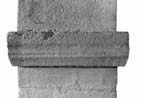
Object type: Impost
Measurements: H. 23 > 22.5 cm (9 > 8.8 in); W. (east–west) 81.5 cm (32 in); D. (south–north) 46 > 34 cm (18 > 13.4 in)
Stone type: Oolitic Limestone
Plate numbers in printed volume: Ills. 234-6
Corpus volume reference: Vol 10 p. 197
(There may be more views or larger images available for this item. Click on the thumbnail image to view.)
Carved impost divided by incised lines into four horizontal bands. The upper zone consists of a flat vertical face. Below this there are two shallow concave mouldings, one wide and one narrow, and below these mouldings there is a chamfer that is slightly concave in profile.
The two imposts are an integral part of the chapel structure and therefore date to 1056. The chancel arch has an unusual horse-shoe shape, as does the arch above the north doorway. This was first noted by Butterworth who recorded the discovery of the chapel and included detailed drawings of the arch and impost section (Butterworth 1886–7, 106–8, pls. IX, X).
