Select a site alphabetically from the choices shown in the box below. Alternatively, browse sculptural examples using the Forward/Back buttons.
Chapters for this volume, along with copies of original in-text images, are available here.


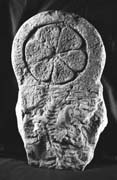
Object type: Part of grave-marker
Measurements: H. 48 cm (19 in); W. 27 cm (10.5 in); D. 7 cm (2.75 in)
Stone type: Light grey (N7), well-sorted, calcareous, clast-supported, quartz sandstone. The sub-angular to sub-rounded clasts range from fine-grained (0.2 mm) to medium-grained (0.3 mm). ?Pendleside Sandstone Member, Lower Bowland Shale Formation, Bowland Shale Group, Carboniferous. N.B. Calcareous sandstones in the Carboniferous are rare and are unknown in the Millstone Grit and Coal Measure sequences. Locally, however, there are such sandstones at the top of the Carboniferous Limestone. Thus, this appears to be one of the few stones for which there is definite evidence of transportation, albeit not very far. The nearest outcrop of the Pendleside Sandstone Member is 4.35 miles (7 km) north north-east.
Plate numbers in printed volume: Ills. 719-20
Corpus volume reference: Vol 9 p. 261
(There may be more views or larger images available for this item. Click on the thumbnail image to view.)
Round-headed grave-marker with part of the shaft. The surviving right side of the shaft joins the head at a sharp angle.
A (broad): A circular area has been cut into the centre of this face. Within is a hexafoil whose leaves are sunk within their raised borders.
B and D (narrow): No decoration
C (broad): Set slightly to the left of the centre of the head is an incised Maltese cross (type B8).
Appendix A item (stones dating from Saxo-Norman overlap period or of uncertain date)
Though round-headed grave-markers are known from both an early and late date within the pre-Conquest period (Cramp 1984, 7), forms with a short stem and discoid head seem to belong to the eleventh and twelfth century. None occur with characteristic Anglo-Saxon ornament like interlace, scrolls or animals. Well-dated examples have come from the late pre-Norman graveyard under Newcastle castle and from the foundations of the church of c. 1150 at Adel in west Yorkshire (Cramp 1984, 244–5, pls. 247.1370, 248.1371; Ryder 1991, 8–9, 50; Coatsworth 2008, ills. 784–95), and others have been published from Northumberland, Co. Durham, Yorkshire, Cumbria, Lincolnshire and Derbyshire which offer analogies for the form, though not for the decoration (Cramp 1984, pls. 232.1314, 234.1325, 258.1403; Lang 2001, ill. 1132; Everson and Stocker 1999, 275; Bailey and Cramp 1988, ills. 624–7; Butler and Jones 1972, pl. I (ii); Ryder 1985, pl. 48; id. 1991, 8–9, 12, 22, 36, 41; id. 2000, 82, 90, 100, 109; id. 2001, fig. 11; id. 2002, 136). In Scotland, Fisher (2001, 17, figs. on 58) has listed examples for which an eleventh-century date is proposed.
The hexafoil ornament may appear to have more in common with some pre-Conquest forms used at the centre of cross-heads (Collingwood 1927a, fig. 68; Cramp 1984, pl. 172.910; Bailey and Cramp 1988, 85; Lang 1991, 169, ill. 582), but it is recorded on a twelfth-century slab from Northumberland (Ryder 2003, fig. 22). The decoration on the reverse is much less accomplished and is also off-centre; it may represent later re-cutting. This type of marker occurs among regional material at Bromborough, Swettenham, Heysham and, probably, Woodchurc Hullh (Ills. 378–9, 381, 382, 527).
