Select a site alphabetically from the choices shown in the box below. Alternatively, browse sculptural examples using the Forward/Back buttons.
Chapters for this volume, along with copies of original in-text images, are available here.


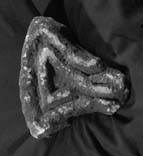
Object type: Cross-arm
Measurements: H. 17.5 cm (7 in); W. 16 cm (6.25 in); D. 11 cm (4.25 in)
Stone type: Greyish orange (10YR 7/4), medium- to coarse-grained, clast-supported, quartz sandstone; grains 0.2 to 1.0 mm, but mostly in the range 0.3 to 0.7 mm; a few white mica flakes up to 1.5 mm; white, ?kaolinised matrix. Helsby Sandstone Formation?, Sherwood Sandstone Group, Triassic
Plate numbers in printed volume: Ills. 9-12
Corpus volume reference: Vol 9 p. 46
(There may be more views or larger images available for this item. Click on the thumbnail image to view.)
The fragment is one (probably lateral) arm of a ring-headed cross, type E, with marked fan-like (penannular) expansion at the end of the arm. The stub of the oval-sectioned ring survives.
A (broad): Within a roll-moulding border is a single strand of interlace, carved in relief, which crosses itself towards the centre of the head after looping round the panel.
B (narrow): Broken away
C (broad): This damaged face carries a roll-moulding border enclosing an angular single-strand loop.
D (narrow): No decoration
E and F (upper and lower): No decoration apart from the stub of the ring originally linking the arms
Penannular cross-heads are popular in eastern Cheshire and western Yorkshire in the Viking period (see Chapter V, p. 33). Such forms combined with a ring are, however, somewhat less common, though the fragmentary heads from Disley Lyme Hall 1 and 2, Bolton le Moors 3, and Monyash in Derbyshire offer geographically close examples (Ills. 128–32, 137–55, 413–14, 417–18; Myers and Barnatt 1984, fig. 1). The Disley parallel raises the possibility that this head came from a round-shaft of type g/h. The minimal decoration probably points to a relatively late date.
