Select a site alphabetically from the choices shown in the box below. Alternatively, browse sculptural examples using the Forward/Back buttons.
Chapters for this volume, along with copies of original in-text images, are available here.


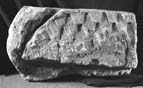
Object type: Part of hogback
Measurements: L. 75 cm (29.5 in); W. (at ends) 20.3 > 17.8 cm (8 > 7 in); (at top) 15.2 cm (6 in); H. (at ends) 47 > 40.6 cm (18.5 > 16 in)
Stone type: Greyish orange (10YR 7/4), moderately sorted, clast-supported, quartz sandstone. The sub-angular to sub-rounded clasts range from fine-grained (0.2 mm) to medium-grained (0.5 mm), but are mostly medium-grained in the range 0.3 to 0.4 mm. ?Pendle Grit Formation, Millstone Grit, Carboniferous
Plate numbers in printed volume: Ills. 425-8
Corpus volume reference: Vol 9 p. 167-8
(There may be more views or larger images available for this item. Click on the thumbnail image to view.)
The stone tapers in section; the one surviving original gable end (D) is plain.
A (long): The ridge of the stone has been dressed. On the roof are two rows of tegulation type 2c with a plain border moulding to the left; any decoration on the vertical wall below has been cut away.
B (end): Cut away; the profile shows clearly that face C has been re-cut.
C (long): This side has been cut away and a secondary decoration added in light relief at the left end. This consists of a forward-facing figure, arms outstretched and grappling with a serpent form. The carving is very flat and facial features are crudely indicated.
D (end): Undecorated
Hogback (see Chapter V, p. 38). Like all four hogbacks which are found south of the Cumbrian peninsular this stone has a coastal location. Within its area it must have been a rare and prestigious type of memorial, asserting the Hiberno-Norse links of the deceased. Though its original shape is somewhat uncertain thanks to its later re-use, it seems to have had the tall narrow proportions of so many Cumbrian and Clyde valley hogbacks. In the twelfth century it was re-used as a tympanum; similar re-cutting of hogbacks in the eleventh or twelfth century has been noted in Scotland at Govan and Tyninghame (Ritchie, A. 2004, 4–5).
