Select a site alphabetically from the choices shown in the box below. Alternatively, browse sculptural examples using the Forward/Back buttons.
Chapters for this volume, along with copies of original in-text images, are available here.


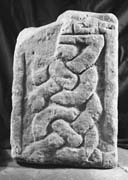
Object type: Part of shaft
Measurements: H. 65 cm (25.5 in); W. 47 > 43 cm (18.5 > 17 in); D. 19 cm (7.5 in)
Stone type: Greyish orange (10YR 7/4), moderately sorted, clast-supported, quartz sandstone. The sub-angular to sub-rounded clasts range from fine-grained (0.2 mm) to coarse-grained (0.6 mm), but are mostly medium-grained in the range 0.3 to 0.5 mm; scattered flakes of white mica. ?Pendle Grit Formation, Millstone Grit, Carboniferous
Plate numbers in printed volume: Ills. 421-4
Corpus volume reference: Vol 9 p. 167
(There may be more views or larger images available for this item. Click on the thumbnail image to view.)
A (broad): Set awkwardly within flanking border mouldings (and with some traces of an upper border) are two ring-encircled twists, executed in a broad strand, terminating at the top in a bar terminal.
B (narrow): Fragments of the lateral border mouldings survive, flanking a three-strand plait.
C (broad): Re-cut with the remains of a border to the right and at the base of the fragment. The figural scene on this face is to be read with the long border at the top. In the centre is a haloed figure whose arms are set akimbo holding a smaller figure, similarly set en face, in front of her. The large figure has a wedge-shaped nose and hollowed ears whilst the facial features of the small child seem to be more realistically rendered. The sub-rectangular moulded outline below may represent a throne or the lower hem of a long dress. To the left is a second (now headless) figure with short kirtle, holding a book against his right hip. In the upper right corner, set on a different plane, is a bearded and possibly seated figure, seen in profile with arms extended in front.
D (narrow): Only the border adjacent to face A survives, together with the remains of a broad-strand plait.
This bold, but badly set-out, shaft carries a ring-encircled twist typical of Viking-period carvings. The broad flat strands are also characteristic of work of this period (see e.g. Brigham 2 — Bailey and Cramp 1988, ill. 133). The re-cutting of face C seems to be of the same style as the secondary, Norman, carving on Bolton le Sands 2 and may have formed part of the same frieze: it includes a Virgin and Child depiction.
