Select a site alphabetically from the choices shown in the box below. Alternatively, browse sculptural examples using the Forward/Back buttons.
Chapters for this volume, along with copies of original in-text images, are available here.


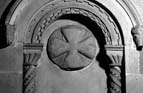
Object type: Slab
Measurements: H. 28 cm (11 in); W. 28 cm (11 in); D. Built in
Stone type: Pale red (5R 6/2), poorly sorted, medium- (0.3 mm) to very coarse-grained (up to 1.5 mm), but mostly coarse-grained in the range 0.5 to 1.0 mm), mostly sub-angular, clast-supported, quartz sandstone; a few small white mica flakes. ?Helsby Sandstone Formation, Sherwood Sandstone Group, Triassic
Plate numbers in printed volume: Ill. 381
Corpus volume reference: Vol 9 p. 144
(There may be more views or larger images available for this item. Click on the thumbnail image to view.)
The circular slab is decorated with a cross of type E6, carved in high relief. There is a slightly raised disc at the centre.
Appendix A item (stones dating from Saxo-Norman overlap period or of uncertain date)
Pre-Norman sculptures on roundels are recorded at Edenham in Lincolnshire from the ninth century where they seem to reflect continental forms of decoration (Everson and Stocker 1999, 160–2, ills. 168–9; Parsons, D. 1989, fig. 1). It is therefore possible that this Swettenham piece is a pre-Norman architectural carving. If so, the wedge-shaped arms would imply a relatively late date in the Anglo-Saxon sculptural sequence: on grave-markers this type of cross has been placed no earlier than the tenth or eleventh century in the south-west (Cramp 2006, 167).
It is however a type of cross-shape which is very familiar on a widespread group of disc-headed grave-markers, like Bromborough 12 and possibly Woodchurch 1 below, which seem to belong to the late eleventh or twelfth century (see Bromborough 12, p. 140; Everson and Stocker 1999, 275), and this points to both the likely original shape and date of the Swettenham stone. If this is accepted then the disc-headed marker must have been cut down for a secondary use.
The stone from which this piece has been carved is not native to the immediate region, having been transported at least 12 miles (20 km).
