Select a site alphabetically from the choices shown in the box below. Alternatively, browse sculptural examples using the Forward/Back buttons.
Chapters for this volume, along with copies of original in-text images, are available here.


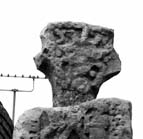
Object type: Part of cross-head [1]
Measurements: H. 27 cm (10.5 in); W. 29 cm (11.5 in); D. 14.5 cm (5.75 in)
Stone type: Not accessed
Plate numbers in printed volume: Ills. 244-5, 273-8, 281-2
Corpus volume reference: Vol 9 p. 120-1
(There may be more views or larger images available for this item. Click on the thumbnail image to view.)
A (broad, east): The lower arm of a cross-head whose ornament is surrounded by a plain moulding. The outline of the stone expands to north and south before curving in to the centre of the head. At the top is a damaged large flat boss superimposed on a human figure (only the lower part surviving) dressed in a flared kirtle and shown walking to the right. A thin vertical moulding links the lower part of the kirtle to the lower border. Single pellets are set on either side of the figure, one to the left above the waist line, and another to the right between the corner of the kirtle and a possible outstretched arm.
B and D (narrow): No decoration visible
C (broad, west): This heavily worn face preserves traces of a lower plain border moulding. Above are the remains of knotwork or entangled scroll.
This may have been part of the head of Sandbach Market Square 2 but is here treated separately. The figural ornament on the east face is clearly related to that on the east face of the head of Sandbach Market Square 1, showing the lower part of a kirtled figure, seemingly walking to the right, with additional boss decoration of the kind familiar on the other Sandbach crosses. In addition, like Sandbach Market Square 1, there is a vertical bar appearing beneath the kirtle.
Hawkes (2002, 164) noted that the stone appears to be upside down in its present position and that it carries remains of its original ringed form. Certainly it reads better, and provides a better parallel to Sandbach Market Square 1, if it is inverted from its present position. But the claimed 'ring' is more difficult to accept. If it were true then it would imply a Viking-age date for the piece (Bailey 1980, 70–1); it would also supply an example, to set alongside Halton St Wilfrid 1 (pp. 179–80), of close tenth-century copying of earlier monuments. It is more likely however that Hawkes has misinterpreted the evidence. Cross-heads with lateral extensions at the base of the neck are known on other Anglian and later free-armed sculptures (Collingwood 1927a, figs. 107, 117, 125; Lang 2001, ills. 311, 907; Coatsworth 2008, ills. 174–7, 713–16); it is probable that this Sandbach fragment should be grouped with them.
