Select a site alphabetically from the choices shown in the box below. Alternatively, browse sculptural examples using the Forward/Back buttons.
Chapters for this volume, along with copies of original in-text images, are available here.


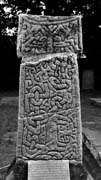
Object type: Part of cross-shaft and -head [1]
Measurements: H. 23 cm (9 in); W. 42 > 40.5 cm (16.5 > 16 in); D. 15 cm (6 in)
Stone type: Fairly well-sorted, light olive grey (5Y 6/1), medium- to coarse-grained (0.3 to 1.0 mm, but mostly coarse-grained in the range 0.5 to 0.7 mm; a few clasts up to 4 mm across), sub-angular (some grains sub-rounded), clast-supported, quartz sandstone (no feldspar). Helsby Sandstone Formation?, Sherwood Sandstone Group, Triassic. N.B. This piece, although basically similar, is overall slightly less coarse-grained than the lower piece (Prestbury. 1).
Plate numbers in printed volume: Ills. 231-2, 234-5
Corpus volume reference: Vol 9 p. 96-7
(There may be more views or larger images available for this item. Click on the thumbnail image to view.)
All four faces are flanked by roll-moulding borders. The east and west faces preserve the curved upper border separating the shaft from the (now largely lost) head; the springer for the slightly wider head is preserved on both narrow faces.
A (broad, west): Relief ornament, now of unidentifiable type, survives on the fragmentary head. On the shaft-panel below is a central vertical moulding which reaches nearly to the top of the panel. This is flanked by a confused ornament which, at first appearance, seems to be formed by irregular stripped scroll and runs of incised stopped-plait which frequently take on meander-pattern forms. This may describe the sculptor's decorative intention. Under certain lights, however, it is possible to interpret the ornament as centring on a tree, its stem represented by the vertical moulding which terminates at the top in a fruit or flower motif flanked by short upward-angled branches. Below this termination are further paired branches: the uppermost short and angled upwards, the next consisting of forms which spring horizontally and then curl back towards the trunk, and the lowest set consisting of a horizontal double moulding which, in the case of the left-hand element, angles back towards the top of the tree. In the upper right quadrant, above a ?serpentine form, is a backward-turned profile beast with its raised rump against the tree, whilst to the left is a bird or animal with long curved neck facing outwards.
B (narrow, south): Below the undecorated remains of the head is a run of four-strand plait. In certain lights the strands appear to terminate at the top in small animal heads with two pointed ears.
C (broad, east): Traces only of relief decoration survive on the head. Below, on the shaft, is irregular knotwork formed by broad, median-incised, stopped-plait strands; the line incising does not reach to the end of the strand unit. Within this knotwork is (at least) one ring and a loose pellet.
D (narrow, north): Below the undecorated remains of the head is a four-strand plait.
The dimensions and, to a lesser extent, the lithology clearly indicate that this stone is not part of the shaft (Prestbury 1) on which it is now placed. Nevertheless, in its combination of broad stopped-plait, stripped scroll (taking on symbol-like shapes) and possible animal forms, it is decoratively close to the larger fragment. The original form of the cross-head is not absolutely certain. Had it had been a circle-head then one would have expected the curved moulding to run over the lateral mouldings of the shaft rather than connect to them as here. Since the springer for the head on both narrow faces suggests that the base of the head was quite broad it is likely that the original form was fan-shaped, a form which is very popular in the eastern part of Viking-age Cheshire (see Chapter V, p. 33). This date is further indicated by the free rings, whilst the treatment of the plait, mixing it with short sections of stripped scroll, meander patterns and other symbol forms — and animal ornament — is close to that of the 'stopped-plait' group of carvings in Cumbria which belong to the same period. Among these carvings Dearham 2 provides a particularly close parallel (Bailey and Cramp 1988, 33–8, fig. 6b, ill. 256), though a somewhat similar treatment occurs in Yorkshire at Barwick in Elmet (Coatsworth 2008, ills. 26–8).
If the 'tree and zoomorphic' reconstruction of the ornament on face A is accepted then the presence of a fruiting tree accompanied by animals (perhaps also a bird and snake) is highly suggestive of the Tree of Life motif (see Bidston 1, p. 50).
