Select a site alphabetically from the choices shown in the box below. Alternatively, browse sculptural examples using the Forward/Back buttons.
Chapters for this volume, along with copies of original in-text images, are available here.


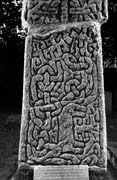
Object type: Part of shaft in two conjoining fragments [1]
Measurements: H. 66 cm (26 in); W. 40.5 > 36 cm (16 > 14 in); D. 24 > 21 cm (9.5 > 8.25 in)
Stone type: Light olive grey (5Y 6/1), medium- (0.3 mm) to very coarse-grained (up to 2.0 mm), but mostly in the range 0.5 to 1.5 mm; a few clasts up to 4 mm across, angular to sub-angular, clast-supported, quartz sandstone (no feldspar). Helsby Sandstone Formation?, Sherwood Sandstone Group, Triassic.
Plate numbers in printed volume: Ills. 230-7
Corpus volume reference: Vol 9 p. 95-6
(There may be more views or larger images available for this item. Click on the thumbnail image to view.)
All faces are flanked by roll-moulding borders; there are no horizontal borders.
A (broad, west): The single panel contains disordered spiral-scroll and knotwork, the latter incorporating four loose rings set around right-angled crossings. In the centre of the lower section is a four-legged animal, standing vertically with legs to the right; his head, at the bottom of the panel, has a round eye and gaping jaws which extend to form interlace strands.
B (narrow, south): At the top is a broad, six-strand plain plait, line-incised at certain points. This plait is set above a human figure, whose facial features are just visible as light incisions, set with legs apart and arms outspread. Beneath the arms, to left and right, are forward-facing figures, whilst there appears to be a triquetra set between his legs. There is meander pattern or angular scroll around his head. No border survives between the plait and figural ornament.
C (broad, east): Above the break in the stone are two human figures, set side by side, with arms outstretched and their main facial features incised. Between their bodies is a tree with pairs of angular downward-spiralling branches. To right and left of the figures is meander pattern or angular stripped-scroll. Further irregular patterns fill the rest of this upper part of the shaft panel with, above each human head, a short straight near-vertical moulding piercing a ring. The rest of the panel, below the break, is filled with irregular knotwork using strands of varying width. In the upper left corner, just below the break, is a (now) headless beast seen in profile and facing right; the two back legs and two forelegs are clearly visible. Near the centre of this part of the stone is a pair of linked ovals forming a St Andrews cross.
D (narrow, north): The upper part of the panel is occupied by a broad four-strand plait with spiral-scroll below. Immediately below the break is a horizontal run of scroll, arranged in a meander pattern, with loose strands terminating to the right in foliate forms. Underneath this are two profile animals, both facing left and set one below the other. The upper beast has a substantial body, four legs, two short pricked ears and a tail; it has gaping jaws reaching down to the horns of the animal below. The body appears to have carried decoration, probably a run of circles enclosing a right-angled crossing (buckle knot). Immediately below is a horseman on a thin steed whose front and back legs are shown in crouched position. The beast has gaping jaws and two extended antlers. The rider appears to hold up one hand behind him; in certain lights this hand seems to grasp a spear, in others to hold an object (?bird). At the bottom of the panel is further spiral-scroll.
The general confusion of ornament on the two main faces, which includes stopped-plait with line incising, stripped scroll, meander patterns, symbolic forms, animal and human elements, is best paralleled among the so-called 'spiral-scroll' group of Viking-age sculptures in Cumbria. Within this group of carvings Dearham 2 provides a particularly close analogue (Bailey and Cramp 1988, 33–8, fig. 6b, ill. 256), though a somewhat similar treatment occurs in Yorkshire at Barwick in Elmet (Coatsworth 2008, 94–5, ills. 26–8) and in Lincoln at St Mark's (Stocker and Everson 1999, 201, ill. 242). In neither the Cumbrian nor Yorkshire examples, however, is animal ornament so closely integrated into the overall confusion.
The figural decoration is puzzling. On face B the figure might reasonably be interpreted as a crucifixion with Mary and John below (Ill. 236). But the double set of similar figures on face C is more difficult to explain (Ill. 233). The peculiar pierced oval over each head might possibly derive from the motif of crowns of victory or immortality; in a more convincing form these can be seen on the Rothbury cross, Northumberland, where they reflect the late imperial iconography of power and authority seen on consular diptychs (Cramp 1984, pl. 212.1210; Hawkes 1996, 84–5; id. 1997c, 34–5). If this identification were accepted then these figures might represent martyrs. Alternatively they might depict the two thieves crucified with Christ, using an iconography seen in the Hypogée des Dunes at Poitiers where the main figure of Christ is set much further up the monument (Elbern 1961; Hubert et al. 1969, pl. 76).
The animal group on face D (Ill. 237) is most closely paralleled, in its stacked arrangement and in its use of additional body decoration, on the Viking-age shaft from Harewood in Yorkshire (Bailey 1986; Coatsworth 2008, ill. 332). Such vertical stacking of beasts is, however, a common response to the restrictions of space on cross-shafts (e.g. Allen and Anderson 1903, iii, figs. 231A, 305A, 307A; Harbison 1992, ii, fig. 166). The animals, with their ugly heads, are characteristic of the free-style beasts of Viking-age sculpture in Northumbria and Man (e.g. Collingwood 1907a, 320; Cramp 1984, pl. 147.774; Lang 1991, ill. 671; Coatsworth 2008, ill. 28; Kermode 1907, nos. 98 and 103). The animal and rider is presumably a version of the common hunt theme discussed under Neston 3 (p. 88). The aristocratic reference of this activity may have been further underlined by the presence of the falcon — if such it be — on the upraised hand of the rider, because falconry is a well-established high-status activity attested in both documents and in early medieval Insular art (Oggins 1981, 175–86; Hicks 1986; Bailey 1996a, 68–9; Henderson, I. 1998, 108–9, 158).
The decoration of Prestbury 2 is closely related to this stone, whilst Prestbury 3, along with Whalley 8, also uses the same rare form of buckle knot (Ills. 238, 691).
