Select a site alphabetically from the choices shown in the box below. Alternatively, browse sculptural examples using the Forward/Back buttons.
Chapters for this volume, along with copies of original in-text images, are available here.


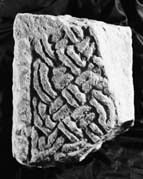
Object type: Part of shaft [1]
Measurements: H. 33 cm (13 in); W. 26 > 24 cm (10.2 > 9.4 in); D. 17.5 cm (17.7 in)
Stone type: Pale red (10R 6/2), moderately sorted, clast-supported, quartz sandstone. The sub-angular to sub-rounded clasts range from medium-grained (0.3 mm) to very coarse-grained (2.0 mm), but are mostly medium- to coarse-grained in the range 0.4 to 0.6 mm. ?Cocklett Scar Sandstone Member, Roeburndale Formation, Millstone Grit, Carboniferous
Plate numbers in printed volume: Ills. 627-30
Corpus volume reference: Vol 9 p. 234-5
(There may be more views or larger images available for this item. Click on the thumbnail image to view.)
Where it survives, all sides are bordered by a cable moulding.
A (broad): Within broad arris borders is a six-strand, median-incised plait.
B (narrow): The single panel contains four-strand, median-incised, knotwork of half pattern F; both borders are damaged.
C (broad): Traces survive of a cabled border moulding to the right.
D (narrow): The single panel contains half pattern A knotwork, similar to face B, but less damaged.
Such tightly-woven median-incised basket plait is popular on Viking-period monuments in Cumbria, Yorkshire and the Isle of Man (Bailey and Cramp 1988, ills. 339, 589, 591; Coatsworth 2008, ills. 23, 40, 438; Kermode 1907, nos. 61, 62, 89, 97).
