Select a site alphabetically from the choices shown in the box below. Alternatively, browse sculptural examples using the Forward/Back buttons.
Chapters for this volume, along with copies of original in-text images, are available here.


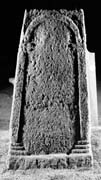
Object type: Socket-stone or lower part of shaft [1] [2]
Measurements: H. 188 cm (74 in); W. 81 > 54 cm (32 > 21.25 in); D. 68 > 37 cm (26.75 > 14.5 in); socket: 30 x 21 cm (11.75 x 8.25 in), 15 cm (6 in) deep
Stone type: Yellowish grey (5Y 7/2), moderately sorted, clast-supported, quartz sandstone. The sub-angular to sub-rounded clasts range from fine-grained (0.2 mm) to very coarse-grained (2.0 mm), but are mostly medium-grained in the range 0.3 to 0.5 mm; a few scattered flakes of white mica. ?Cocklett Scar Sandstone, Roeburndale Formation, Millstone Grit, Carboniferous
Plate numbers in printed volume: Ills. 558-61, 565
Corpus volume reference: Vol 9 p. 214-5
(There may be more views or larger images available for this item. Click on the thumbnail image to view.)
This tall, truncated pyramidal stone has a broad flat moulding around the base and a rectangular socket in the top. Each face carries an arched frame formed by a flat moulding set on a triple-slab base; the arch springs from a double-slab capital. In certain lights it is possible to distinguish the remains of large forward-facing figures set within these frames.
Though it is possible that this stone represents the lower part of a shaft which has later been cut down, it is more likely that its original function was as a socket. Pyramidal-shaped sockets are familiar in Irish sculpture of all periods, both carrying decoration (e.g. Harbison 1992, ii, figs. 24, 93, 99, 107, 114, 311, 472, 491) and with simple moulding outlines (ibid., figs. 112, 115, 215, 237, 326). The type is known in Wales and, though not well recorded in Scotland, the form also occurs there (Nash-Williams 1950, nos. 38, 206; Forsyth 1995, fig. 2; Fisher 2005, 88). In England the base of the Auckland St Andrew stone provides an elaborately decorated example from the late eighth or ninth century, whilst others, carrying minimal or no ornament, have been recorded at Lindisfarne (Cramp 1984, pls. 5.15, 196.1103, 198.1108, 199.1110). The tall pyramidal shape finds further parallels in Unknown Provenance 2, Cumbria, and in sockets from Birstall and Rastrick in the West Riding of Yorkshire (Bailey and Cramp 1988, ills. 668–71; Coatsworth 2008, ills. 69–73, 626–30). But none of these examples are as massive as Hornby; only the base at Hartshead in Yorkshire approaches its dimensions though it lacks Hornby's tapering shape on two of its faces (Coatsworth 2008, ills. 310–13). In summary, this base is a strikingly large and ambitious version of a form which was widespread in Insular sculpture.
The frame consists of a triple-stepped base and double slab imposts; this is exactly paralleled at Hoddom in the ninth century — though there with an additional horizontal lintel below the arch (Cramp 1970, Taf. 47). Stepped imposts are known in Anglo-Saxon architecture (Taylor, H. M. 1978, 1052–5), and figure in eighth-century art on the Franks Casket, the Codex Amiatinus and a sequence of Insular manuscripts beginning with the Lindisfarne Gospels (Webster and Backhouse 1991, no. 70; Bruce-Mitford 1969, pl. XVI; Alexander 1978, ills. 32, 162–4, 173). Most stone sculptural examples, however, seem to belong to the ninth century (Cramp 1970, Taf. 42, 44; Webster and Backhouse 1991, no. 208; Bailey 2005, 9–10, pl. 4; Coatsworth 2008, ills. 167, 169, 196–7, 564). Cramp has argued, particularly in view of the occurrence of such forms in the Utrecht Psalter, that the origin of this feature is ultimately Near Eastern (Cramp 1970, 60)
The four near-obliterated figures beneath the arches are likely to have been representations of the Evangelists. In size they can best be compared in Northumbria to those on the west face of the Bewcastle cross (Bailey and Cramp 1988, ill. 90) — a comparison which indicates the impressive appearance of the original monument. Their position at the base of the cross is a visual statement of their role as the basis of a faith which reaches out to the four corners of the earth, analogous to their position under a twelfth-century altar at Lalibela in Ethiopia (Werner 1981, fig. 7). From early within the tradition of Christian exegesis, Iraneus provides an appropriate explanatory gloss to the Hornby carvings in a passage which encapsulates much of the well-rehearsed argument for the existence of only four gospels: 'since there are four regions of the world in which we exist, and four principal winds, and since the church, spread out over all the world has for a column and support (1 Timothy III, 15) the Gospel and the spirit of life, consequently it has four columns, from all sides breathing imperishability and making men live' (Grant 1997, 131; see also Elbern 1966, Cronin 1995 and O'Reilly 1998 for associated quadriform arguments).
[1] The following are unpublished manuscript references to the Hornby stones: BL Add. MS 37550, items 650–62, 688, 692, 696; Manchester Public Library, Hibbert Ware S. MSS: Msf 091 H21, vol. 4, 158.
[2] The following is an unpublished manuscript reference to no. 3: Manchester Public Library, Hibbert Ware S. MSS: Msf 091 H21, vol. 4, 158.
