Select a site alphabetically from the choices shown in the box below. Alternatively, browse sculptural examples using the Forward/Back buttons.
Chapters for this volume, along with copies of original in-text images, are available here.


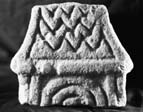
Object type: Part of cross-shaft and -head [1]
Measurements: H. 18 cm (7 in); W. 22 cm (8.5 in); D. 12 > 10.5 cm (5 > 4.25 in)
Stone type: Pinkish grey (5YR 8/1) moderately sorted, clast-supported, quartz sandstone. The sub-angular to sub-rounded clasts range from fine-grained (0.2 mm) to very coarse-grained (2.0 mm), but are mostly medium- to coarse-grained in the range 0.4 to 0.6 mm; white chalky matrix. ?Cocklett Scar Sandstone, Roeburndale Formation, Millstone Grit, Carboniferous
Plate numbers in printed volume: Ills. 553-7
Corpus volume reference: Vol 9 p. 213-4
(There may be more views or larger images available for this item. Click on the thumbnail image to view.)
A (broad): The lower part of the head, probably of type C10 with wide curved armpits, retains its roll-moulding borders and is decorated with two rows of horizontal zigzag patterns set one above the other. The lower end has been left uncut. The shaft is flanked laterally by a narrow arched moulding within a double roll-moulding frame and seems to have been decorated with a human figure: a halo, hair and the forehead are all that now survive.
B (narrow): The side of the head carries a series of four parallel mouldings set one above the other, whilst the shaft, flanked by single roll-moulding borders, carries the upper part of a spiral scroll with a central rosette fruit element.
C (broad): The head carries three runs of zigzag pattern comparable to face A but, in the lower part of the face, each triangle is filled with a small pellet. The shaft has a double border as on face A and contains the upper line of an inscription.
Inscription All that can clearly be read of this roman-script inscription, as Okasha (1971, 81) reports, is:
D (narrow): Four horizontal mouldings, set one above the other, survive on the side of the head, whilst there are traces of scroll on the shaft; all is set within single border mouldings.
This stone provides another example of a literate monument in the Lune valley (Chapter IV, p. 20), and in many of its details the ornament is typical of work from the immediate area. Thus the horizontal mouldings on the narrow faces are identical to those on the nearby Gressingham 3; they are also found further down the valley at Lancaster St Mary 2 and Capernwray Hall, as well as on a cross-head from Northallerton (Ills. 439, 441, 473, 475, 570, 572; Lang 2001, ills. 675–6). The head would also plausibly restore as the same E10 type of Gressingham 3 (Ills. 472–5). Haloed or haired figures set under their own arches (distinct from the arris border) occur at Halton and Heysham on work of the pre-Viking period (Ills. 479, 481, 489, 499, 511). The closest parallel for the horizontal zigzag decoration is supplied by a Viking-age shaft from Burton in Kendal, Westmorland (Bailey and Cramp 1988, ills. 191–2), but there the motif is incised and it is perhaps more relevant to note the chevron ornament of Hornby 1 which is filled with pellets, as on face C of this stone (Ills. 549, 554). The rosette fruit cluster is repeated locally at Lancaster (Ills. 571, 573, 575).
Inscription No interpretation suggests itself. Okasha (1971, 81) notes that Collingwood's attempt to read it as an abbreviated form of In nomine Domini 'does not seem very likely'.
