Select a site alphabetically from the choices shown in the box below. Alternatively, browse sculptural examples using the Forward/Back buttons.
Chapters for this volume, along with copies of original in-text images, are available here.


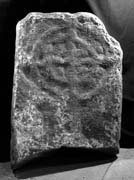
Object type: Slab in three joining pieces, two now lost [1]
Measurements:
Of original slab (after Smith, H. E. 1865)
H. 163 cm (64 in); W. 53.5 < 56 > 43 cm (21 < 22 > 17 in); D. Not recorded
Of surviving piece
H. 81 cm (32 in); W. 56 cm (22 in); D. 10 cm (4 in)
Stone type: Whitewashed and not visible
Plate numbers in printed volume: Ill. 176
Corpus volume reference: Vol 9 p. 81-2
(There may be more views or larger images available for this item. Click on the thumbnail image to view.)
Decoration only survives on the broad face where there are traces of a border moulding on all sides. The ornament is in low relief and shows a cross-head, type C1 with rounded terminals, whose arms are linked by two concentric rings. Within the inner ring are four bosses set in the spandrels. Ecroyd Smith depicts four further bosses between inner and outer rings; traces of these still survive to the right (Smith, H. E. 1871c, pl. facing 32). The shaft below shows some signs of the 'swelling' noted in Collingwood's drawing. That drawing shows the lower part of the shaft as forked and flanked by traces of an angular open plait or chevrons (Collingwood 1928, fig. 7).
Cross forms with bosses or cup-shaped depressions between the arms are not uncommon on slabs in Wales, Man and Scotland (Nash-Williams 1950, nos. 52, 58, 131, 173, 361, figs. 5, 6; Kermode 1907, pl. VIII; Fisher 2001, figs. 4–6, 8; Henderson and Henderson 2004, ills. 235, 236, 241) and there is an isolated example also from Cumbria at Addingham (Bailey and Cramp 1988, ills. 15–16). The particular form with double ring used here has two close parallels on slabs in Wales (Nash-Williams 1950, nos. 51, 125, pls. XV, XVI) dating, in one case, to the early ninth century. There is another Welsh example on a free-standing cross from St Edrins, which has been dated to the tenth century and linked to carvings from Hiberno-Norse Dublin (Edwards, N. 2007b, 192–4, pl. 10; Ó héailidhe 1973, figs. 1–2). These analogues suggest that the ornamental links of the Hilbre stone lie in the Celtic west.
More telling for chronology is Collingwood's observation that there are other slabs with swollen cross-stems; he cited Kirkclaugh, Minnigaff and Anwoth in Galloway which he believed to be of the Norman period in view of their association with Norman mottes or chapels (Collingwood 1927a, fig. 226; id. 1928, 22; Thomas 1967, fig. 30). Romaldkirk in Yorkshire provides a further example which Cramp has dated to the eleventh century (Lang 2001, 284, ill. 1183). The possible angular plait or chevron pattern which flanks the cross-shaft points in a similar direction because it also appears to be a motif of the late eleventh or early twelfth century (see West Kirby 6, p. 145).
Allen (1895, 173) noted that the bifurcated foot to the cross might allude to the Christian 'fish' symbol; a similar form of terminal appears on the crucifixion scene at Colonsay in Argyll (Fisher 2001, 140). Both may, however, represent a version of a simple bifid terminal (see Nash-Williams 1950, figs. 3, 6).
