Select a site alphabetically from the choices shown in the box below. Alternatively, browse sculptural examples using the Forward/Back buttons.
Chapters for this volume, along with copies of original in-text images, are available here.


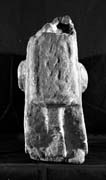
Object type: Part of cross-head [1]
Measurements: H. 38 cm (15 in); W. 51 cm (20 in); D. 15 cm (6 in)
Stone type: Greyish orange-pink (5YR 7/2) on fresh surface, weathered to pale brown (5YR 5/2), medium- to coarse-grained (0.3 to 1.0 mm, but mostly medium-grained in the range 0.4 to 0.5 mm), sub-angular to sub-rounded, clast-supported, quartz sandstone. Bedding parallel to surface. Chester Pebble Beds Formation?, Sherwood Sandstone Group, Triassic
Plate numbers in printed volume: Ills. 172-5
Corpus volume reference: Vol 9 p. 81
(There may be more views or larger images available for this item. Click on the thumbnail image to view.)
Lower part of circle-head, with unpierced spandrels and with small fragment of top of shaft; cross type B10
A (broad): The circle carries a type 2 meander pattern around the ring, bordered by a roll moulding. The spandrels are not pierced but carry small bosses in the armpits. At the centre is a flat boss, with a pierced central hole. Triquetra fill the surviving left and lower arms which are flanked by border mouldings.
B (narrow): No decoration visible
C (broad): As face A
D (narrow): A roll-moulding frame survives on the end of the arm; within are traces of linked triquetra.
Circle-head (see Chapter V, p. 31). The ornamental repertoire of armpit bosses, pierced central boss and triquetra is repeated elsewhere in the group (cf. Ills. 75–99). The main distinction from the rest of the Cheshire circle-head series is that the circle is decorated with a Viking-period meander pattern.
