Select a site alphabetically from the choices shown in the box below. Alternatively, browse sculptural examples using the Forward/Back buttons.
Chapters for this volume, along with copies of original in-text images, are available here.


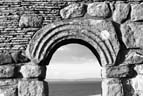
Object type: Lintel [1][2]
Measurements: H. 58 cm (23 in); W. 118 cm (46.5 in); D. 20 cm (8 in)
Stone type: Greyish pink (5R 8/2), well-sorted, clast-supported, quartz sandstone. The sub-angular to sub-rounded clasts range from fine-grained (0.1 mm) to medium-grained (0.3 mm), but are mostly fine-grained (0.2 mm). Ward's Stone Sandstone Formation, Millstone Grit, Carboniferous
Plate numbers in printed volume: Ill. 545
Corpus volume reference: Vol 9 p. 209-10
(There may be more views or larger images available for this item. Click on the thumbnail image to view.)
The arched door-head is carved from a single monolithic lintel on whose external face are three raised concentric semi-circles following the line of the arch below. The outer edge of the lintel curves on the left side but is more rectangular on the right.
The structural analysis by Potter and Andrews shows that the door using this lintel could be part of the Phase 1 building, which can probably be assigned to the eighth century, but that it is here re-used in the undated Phase 2 (Potter and Andrews 1994, 66, 72). There is a comparable form of decoration on the doorway of Somerford Keynes in Gloucestershire which has been assigned to a variety of dates between the eighth and tenth centuries (Brown, G. 1925, 190–1, fig. 75; Heighway 1987, 133). Other parallels can be cited from Seaham in Co. Durham, dated seventh to ninth century, and both Great Hale and Marton in Lincolnshire which belong to the tenth or eleventh century (Cramp 1984, 135; Everson and Stocker 1999, 227–8, 311). There are other undecorated lintels with arches cut from their underside at the site (Potter and Andrews 1994, 70, figs. 14, 39, 40).
[1] The difficulties of distinguishing between the original provenances of sculpture from this site have been emphasised by recent excavations (Potter and Andrews 1994, 104, and fig. 2). The following list therefore combines material from both St Peter's church and St Patrick's chapel.
[2] The following are general references to the Heysham stones: Robson 1850, 28; Jackson 1889, 33; Allen 1894, 4, 8; Micklethwaite 1898, 348–9; Taylor, H. 1898, 42; Howarth 1899, 9, 21; Nicholson 1899, 21; Grafton 1904; Ditchfield 1909, 117; Grafton 1909; Farrer and Brownbill 1914, 110; (–––) 1923, 288; Curwen 1925, 30; Collingwood 1927a, 15; Hogarth 1934; Bu'lock 1972, 67; Fellows-Jensen 1985, 402, 405; Crosby 1998, 30; Higham, N. 2004a, 27; Blair 2005, 216, 218, 309, 376, 457; Salter 2005, 42; Newman, R. M. 2006, 103.
The following are unpublished manuscript references: BL Add. MS 37550, items 617–46, 735–6; BL Add. MS 37551, items 72–5; Lancaster Public Library, no. PT 7; Manchester Public Library, Hibbert Ware S. MSS: Msf 091 H21, V, 64 (no. 5), 82 (no. 1); vol. 8, 98v. For the Hibbert Ware collection see Henry and Trench-Jellicoe (2005, 239–60).
