Select a site alphabetically from the choices shown in the box below. Alternatively, browse sculptural examples using the Forward/Back buttons.
Chapters for this volume, along with copies of original in-text images, are available here.


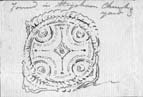
Object type: Part of ?round-headed grave-marker [1][2]
Measurements: Not recorded
Stone type: Unobtainable
Plate numbers in printed volume: Ill. 527
Corpus volume reference: Vol 9 p. 205-6
(There may be more views or larger images available for this item. Click on the thumbnail image to view.)
The drawing, which carries no scale, shows one face of a round-headed stone. At the top a double cable moulding encircles a cross of type E10. Within the unpierced spandrels are encircled (and possibly drilled) bosses. On the surface of the cross is an incised cruciform motif, whose four arms emerge from a central lozenge shape, its sides gently incurving, and terminate in a drilled hole. There may have been a further encircled boss at the centre of the lozenge. Below the encircled cross are the remains of a shaft or slab.
The surviving drawing suggests that this carving was part of a disc-headed slab, though it would be possible to reconstruct the piece as a form of circle-headed cross with bosses or cylinders at the junction of head and shaft. If the latter reconstruction is accepted then this Heysham piece would represent an isolated outlier of the Cheshire group of circle-heads (p. 31), though completely individualistic in its double cable moulding and its elaborate cruciform shape.
A reconstruction as a disc-headed grave-marker would best fit the double-moulded surround — which is very persistent in the group — and the traces of a broader shaft below the encircled cross. This type of stone is discussed above under Bromborough 12 (p. 140); the form appears to belong to the eleventh century or later, but the elaborate decoration of this example suggests that it belongs early in the series.
The combination of cruciform and lozenge shapes is one which is familiar across a range of Irish carvings (e.g. Lionard 1961, figs. 6, 18, 19, 25; Harbison 1992, ii, fig. 364, Kilbroney cross). But it also occurs on Anglo-Saxon coinage. All may ultimately reflect concepts of the Creator/Logos and universal harmony (see Anderton 1, p. 162; Sandbach Market Square 2, p. 118; and the discussions in Richardson, H. 1996 and O'Reilly 1998).
[1] The difficulties of distinguishing between the original provenances of sculpture from this site have been emphasised by recent excavations (Potter and Andrews 1994, 104, and fig. 2). The following list therefore combines material from both St Peter's church and St Patrick's chapel.
[2] The following are general references to the Heysham stones: Robson 1850, 28; Jackson 1889, 33; Allen 1894, 4, 8; Micklethwaite 1898, 348–9; Taylor, H. 1898, 42; Howarth 1899, 9, 21; Nicholson 1899, 21; Grafton 1904; Ditchfield 1909, 117; Grafton 1909; Farrer and Brownbill 1914, 110; (–––) 1923, 288; Curwen 1925, 30; Collingwood 1927a, 15; Hogarth 1934; Bu'lock 1972, 67; Fellows-Jensen 1985, 402, 405; Crosby 1998, 30; Higham, N. 2004a, 27; Blair 2005, 216, 218, 309, 376, 457; Salter 2005, 42; Newman, R. M. 2006, 103.
The following are unpublished manuscript references: BL Add. MS 37550, items 617–46, 735–6; BL Add. MS 37551, items 72–5; Lancaster Public Library, no. PT 7; Manchester Public Library, Hibbert Ware S. MSS: Msf 091 H21, V, 64 (no. 5), 82 (no. 1); vol. 8, 98v. For the Hibbert Ware collection see Henry and Trench-Jellicoe (2005, 239–60).
